| European Air War By Jim "Twitch" Tittle |
||||
|
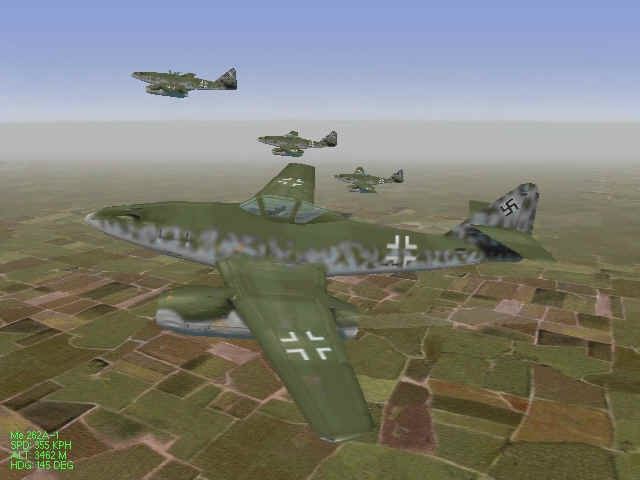
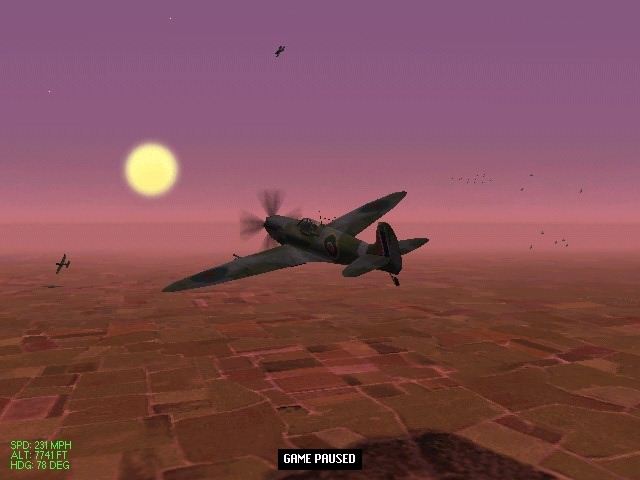
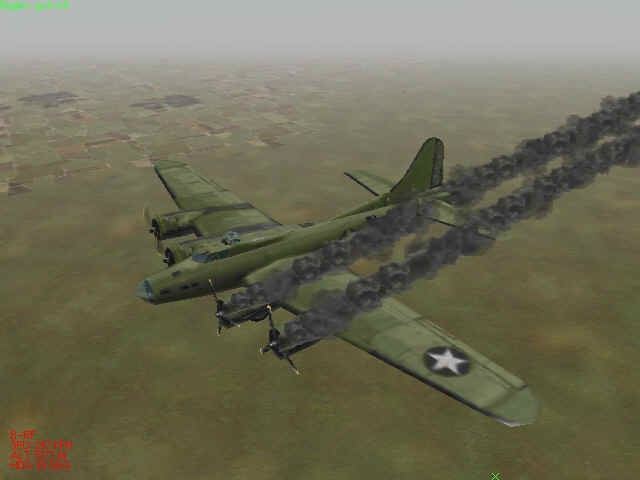
"Meat on the table," is what Thunderbolt ace Bob Johnson called the Me 110. ("Me" because that's what aces of the time knew them as, not "Bf".) The rear gunner squirts a feeble stream of seven point nines vaguely in your direction as your .50's get him smoking good from 300 yards. You touch the trigger again and he disintegrates into a big ball of flame. Your wingman congratulates you as you bank away to avoid the pieces, searching for another victim. WWII IS BACK! You'll experience the above scenario, and much more, in Microprose's European Air War. All the heavy metal is there too. Fly-able is the P-38H & J, P-47C & D, P-51B & D, Hurricane I, Spitfire Ia, IX & XIVE, Typhoon IB, Tempest V, Fw 190A8 & D-9, Bf 109E-4, G-6 & K-4, Bf 110C & G, plus the Me 262. (See Jim's earlier article on the aircraft of EAW). Bombers you will meet are the B-17, B-24, B-26, Mosquito, Ju 87, Ju 88, He 111, plus the V-1's. Some of these aircraft have never before been modeled in a simulation. Even if they have, it's never been this good. This is what all of the World War II air combat fans have been waiting years for. GRAPHIC IMAGES First, but not foremost, is the graphics. I compare previous WWII sims such as Secret Weapons of the Luftwaffe, Aces Over the Pacific, Aces Over Europe and Pacific Air War's graphics to Warner Brothers cartoons. Everything is defined and clear enough but it's all like a neatly done coloring book. Color is brighter and every line of every object in the air and on the ground is totally distinct. EAW is more like a well illustrated comic book. It is not cartoonish yet not photographic quality either. More realistic, it leans towards a fine, detailed aviation oil painting by Stan Stokes or Roy Grinnell. Paint schemes are immaculate showing weathering and wear. Squadron markings are good enough in detail to be recognizable. Everything looks right. I personally do not want too much terrain detail. After you fly over a few times and "gee whiz" about it, it's just ground clutter when you're trying to pick up that 109 turning at 10 o'clock low. EAW does quite well in this respect. As you focus on the gray camo 109G clearly, the surrounding realistically blurs away.
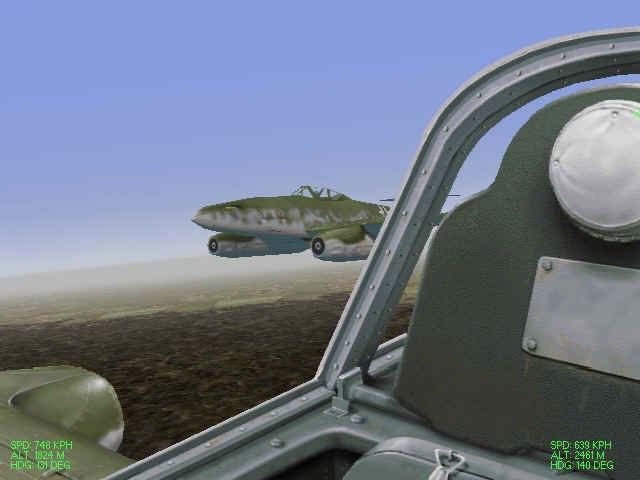
VIEWING ROOM Simulation designers have a tough job in creating views. Nothing is like turning your head and moving your eyes in a real cockpit. We must rely on punching view controls or padlock an object. The padlock will project the object chosen on the screen, no matter which direction it is relative to the way you are flying. Disorienting at first, you can practice and soon coordinate your stick and rudder moves to line up the enemy plane in the sight ring. It is the nearest thing there is to natural, reflex, line of sight viewing. One good crutch is the target info that brackets the on-screen object with range, aircraft type and heading. Altitude and speed read out on an unobtrusive HUD at the lower right of the screen. Jet sims have used it for ages in target acquisition at long ranges. You can select the amount of info displayed over a given target.
|
I can rationalize this aid because in reality you can see so much better at WWII combat ranges than off of the dumb monitor screen. Your 17-19" screen is about the size of an open comic book, and you're doing a "where's Waldo" on the pages. Next time you're really in a 737 descending at 5,000 feet going 250-300 mph, note how much detail your eyes take in. No contest. I can tell you that, with perfect clarity, you will see an aircraft traversing the screen at 1/4 mile away. As with all of European Air War's features, if you do not like them, you can turn them off. Over all the view dynamics are really fine. You immediately get the "big sky" sensation. The old WWII sims took in a scope of about a mile around your A/C, aircraft. EAW can make you feel very alone in the sky, taking in tens of miles of view at a time. Read any combat narrative and pilots relate the same feeling. Target tracking left on will read out to 500,000 feet behind you! Weather effects are nicely done. Chasing a 109 over France in a P-47C you'll find yourself slipping in and out of wispy, low marine layers of coastal clouds. The haze on the horizon is perfectly real. The size of the enemy aircraft is a tough to model to suit all. The plane is larger at all ranges than previous WWII simulations but I believe that some will still find them small. You can use the "+" key to zoom in from 700 yards with .50 caliber and 20 millimeter being deadly. Input through the joystick is amplified during zoom so slight movements are the order. The orange tracers guide you without being too bright.
SHOOT TO KILL The two settings for gunnery are "easy" and "realistic." At killing range of 200-300 yards an E/A, enemy aircraft in a smooth turn is VERY hard to hit in "realistic." On "easy" it seems more real to me as you see errant strikes noted with flashes and smoke puffs as the A/C is lightly hit. When you are missing solid hits the few rounds that are in the vicinity give you hints for adjusting. I've heard many pilots speak of this. In "realistic" you just plain miss. At six o'clock it seems about the same on either setting. Few planes have ammo rounds counters and you must be prudent with your ordnance, like real. Quick bursts squeezed off are the only way to excel. One neat, realistic feature is the gun feed stoppage you randomly get on a weapon. Flying through bomber debris in the Me 262 put all my 30mm's out of action once.
Weapon sounds are a bit puny for my taste relative to the engine sounds. The four .50's on the P-51B sound about like the eight on the P-47. The 30mm is a nice thumper so best turn it all up to savor all the audio. Go to Part II
|
|||
|
© 1997 - 2000 COMBATSIM.COM, INC. All Rights Reserved. Last Updated November 22nd, 1998 |
||||