| Cold Steel: EAW Aircraft by Jim "Twitch" Tittle |
||||
|
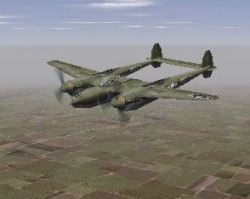
European Air War from Microprose promises to be yet another in a gaggle of great WWII flight sims on the horizon. Let's cover some of the aircraft not highlighted in "Heavy Metal", the article reflecting the aircraft in Janes' WW2 Fighters that was seen on COMBATSIM.COM some months ago. LOCKHEED P-38H-J LIGHTNING The P-38H performance specs follow the "J" closely save for the lack of inter-cooler and oil radiator intakes below the propshaft. The Lightning never gained the ascendancy in Europe that it did in the Pacific. The Luftwaffe had plenty of high altitude aircraft that the Japanese did not and this nullified the advantage the P-38 had; swooping down on its prey. It easily took part in long-range escort missions with its ample 2,260 mile range. In the Mediterranean It was dragged down to low altitude in most fights and never excelled.
Two Allison V-12s of 1,425 h.p. gave the "J" a climb rate of some 3,000 f.p.m. while on its way to a 44,000 foot ceiling. At 30,000 feet the Lightning managed its 414 m.p.h. top speed. The 20mm cannon and four .50's mounted in the nose were easier to hit with compared to wing mounted guns that were most effective at certain convergence ranges. The P-38 could tote ten 5 inch rockets and up to 3,200lbs. of bombs and was successful as a ground attack plane but was phased out of air to air work as P-47s and P-51s became plentiful. The key to success was the basic energy fighter concept- high speed slash through of the enemy formation. You can see this modeled in most sims artificial intelligence as the American fighters go way, way out to take advantage of the speed, inertia, and distance before they turn to face you with their guns down your throat. REPUBLIC P-47C THUNDERBOLT The P-47C arrived in England to equip three USAAF fighter groups in January 1943. Outwardly the main difference from the "D" model in appearance was the rear fuselage decking build up and the "birdcage" canopy. Climb was later improved with the use of paddle-blade airscrew on the "D." Otherwise performance was similar. The "Jug," as it was fondly nicknamed, was large for a single- engined fighter. Sitting behind the imposing 2,300 h.p. Pratt & Whitney 18 cylinder radial, the pilot functioned from the oversized cockpit. But the 14,000 pound plane was quick with a 433 m.p.h. top end at 30,000 ft. The P-47 had a good roll rate and was maneuverable for its size. Before the paddle blade props were installed, initial climb rate was on the order of 2,800 f.p.m. The massive firepower of 425 r.p.g. of the eight .50's API (armor piercing incendiary) ammo was savored by those who flew the 'Bolt. Once an enemy aircraft was in the P-47's sights it was usually all over as the fifties tore the enemy to shreds. Large drop tanks improved the short internal fuel range of some 640 miles to 1,250 miles. Thunderbolts were used increasingly as ground support aircraft as P-51s became available in numbers. 2,000 lbs. of bombs or ten 5 inch rockets could be carried for this purpose. 203 were sent to Russia on Lend-Lease. The Brazilian Air Force and the French even flew against the Luftwaffe from Corsica in 1944. Stories of its ability to take heavy damage and out dive anything in the air are legendary amongst those who knew the Jug. The leading American ace in Europe, Francis Gabreski with 31 kills, flew it.
|
NORTH AMERICAN P-51B MUSTANG Like the P-47C, the P-51B had a notch-back fuselage which was revamped to use the teardrop, all around vision canopy. Even though the "B" mounted but four .50 caliber machine guns, a pilot with a good shooting eye could make triple scores with 280 r.p.g. inboard and 350 r.p.g. for the outboard pair. Performance was very similar to the later "D." It was created in a mere 117 days but lived up to every aspect that was sought out by U.S. fighter pilots who desperately needed an upper hand. With a range of 2,200 miles it could stay with the "big friends" all the way to Berlin and beyond. The 1,695 h.p. Packard-built Merlin V-12 propelled it to 440 m.p.h. at 25,000 feet. Its ceiling was 42,000 feet and rate of climb of 3,200 feet per minute. With a competent pilot it was able to maneuver with most any German plane though classic dogfights were rare. The Mustang truly owned the air over Germany and many Luftwaffe pilots were very apprehensive of engaging them in a one on one basis. Once the 4th Fighter Group had Mustangs they matched the best German fighters turn for turn if need be and began running up good scores. American pilots generally used the advantage of altitude with speed and slash techniques to pass through the enemy formation, pick a target and fire on it; try it in sims, it works. Up to 2,000 lbs of bombs or six 5 inch rockets could be slung beneath the P-51 for ground attack work. MARTIN B-26 MARAUDER It was fast low altitude weapon traveling 283 m.p.h. at 5,000 feet. It held 4,000 lbs of bombs. The crew of six had up to eleven .50 caliber machine guns with 4,400 rounds of ammo. Once the high landing and stall speeds were mastered crews had no real problems with the B-26. Climb was good for a heavy plane at 1,000 f.p.m. Missions were up to 1,100 miles in length; usually five hours long. CONSOLIDATED B-24 LIBERATOR With 18,188 built, this bomber far surpassed the 12,677 quantity of B-17s. The "J" model could fly 300 m.p.h. at 30,000 feet with a 5,000 lb. bombload. Its crew of ten had that many .50s and 4,716 rounds of ammo for protection. It could climb at 1,025 f.p.m. and it 1,700 mile range usually meant a seven hour mission. Not able to absorb the damage that the B-17 could, the loss of one engine meant sweating out a long return to base. "Libs" became the scourge of the U Boats in their anti-sub Atlantic patrol duties.
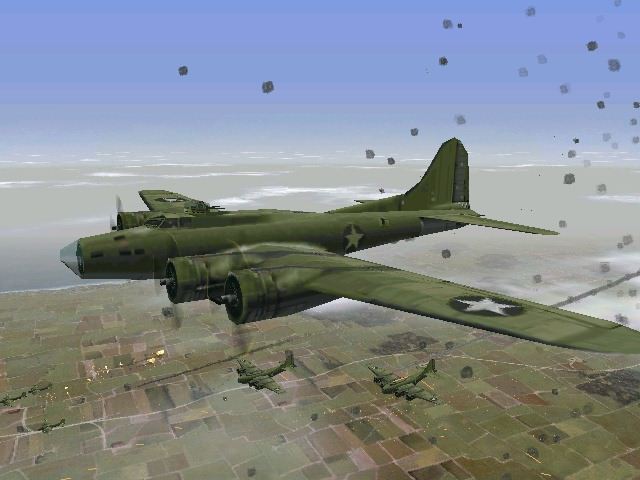
BOEING B-17 FLYING FORTRESS Originally conceived when the theory was that a fast, heavily armed bomber could complete its mission and defend itself, the B- 17 did bring many crews home even with severe damage and just two engines. But before the P-51 escort fighters were available to fend off the enemy, huge losses began to mount. The "G" was the consummate model of the line with 13 .50 caliber guns and 5,770 rounds of ammunition operated by the ten man crew. It could fly at 300 m.p.h. at 25,000 feet. Climbing at 900 f.p.m., it was able to tote 5,000 lbs of bombs some 1,850 miles which was nearly nine hours for a mission. It could haul up to 17,600 lbs. at short ranges. Go to Page Two
|
|||
|
This material is copyrighted and may not be reprinted in any form without
permission of the publisher.
Last Updated November 1st, 1998 |
||||