| European Air War By Jim "Twitch" Tittle |
||||
|
TORQUE IT UP The engine sounds are generally good and are distinctive to each plane. I expected a more characteristic roar when adding full throttle and dumping a quart of simulated av gas into the cylinders. Throttle response leading to acceleration may or may not suit you. It's a difficult area to model so that everyone will like it. Torque effects can be turned on and off. The "on" setting will give a tendency to roll around the center axis and countering this with opposite rudder, as combat pilots did, does not correct it. You must use the ailerons. Uncharacteristically, you fight to hold a heading when even torque monsters such as the P-47 were neutral in cruise trim. Even with torque turned off the aircraft seem to turn tighter one way than the other.
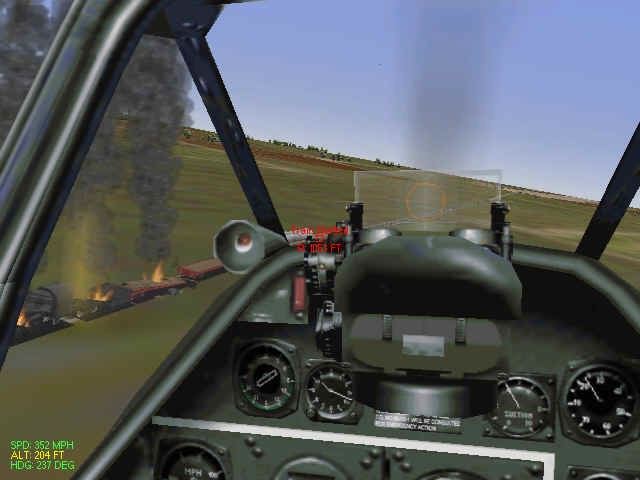
The gauges are adequate, but not as clearly legible as some would prefer. Every combat pilot I've ever talked to said the same thing you will: "in combat you keep your eyes on the enemy, never looking at the instruments- you just listen to the engine." MISSIONS In single missions you can set up the parameters you want. You may select the A/C you wish to face and what machines you want to face them with. The level of the enemy can be green, veteran, or ace. If you are sim experienced I'd suggest the "ace" setting for the Allied side. On the German side beware of those intercept missions and expect to get hurt. Your wingman will soon be exhorting you to get out of your crate once a wing tears off!
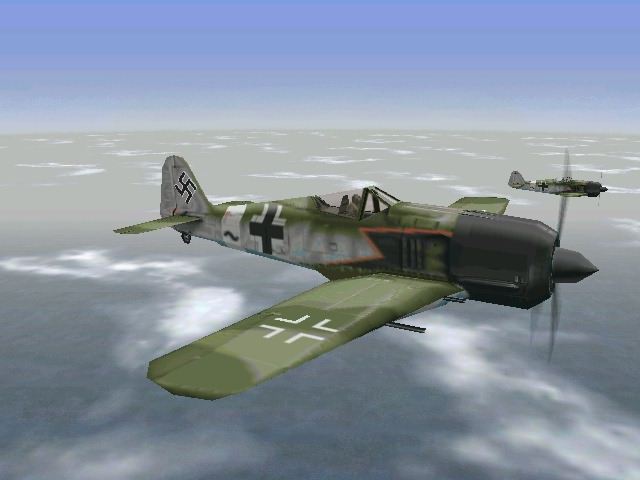
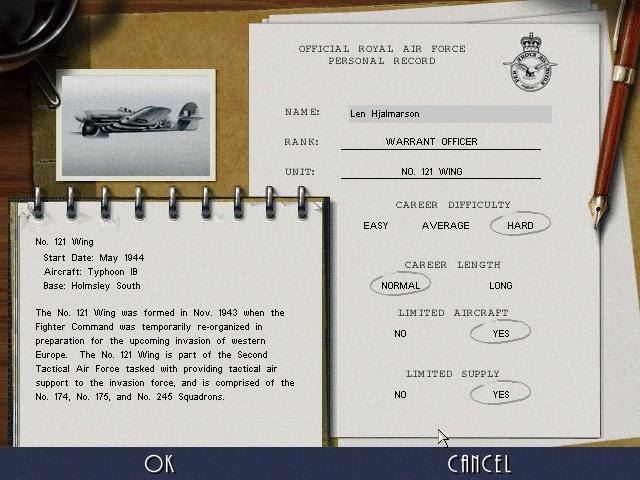
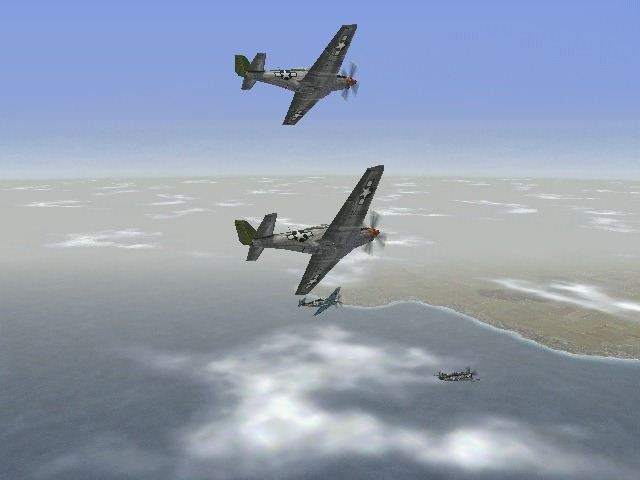
Running careers is where it's at. I signed up to a P-51B outfit and got a triple on my first mission and a double the next with the setting for the enemy on "veteran." With Zemke's Wolfpack flying the P-47C is a bit more difficult. In 1940, as a German in the 109E-4, I had a tougher time. It took four missions to become an ace. Dang, those Tommies can turn! In the G-6 in 1943 against the heavies is near suicide! Flying a Spit Ia vs He 111's and Ju 88's seemed too easy on "veteran" though. Relatively, the Ju 88 is harder to knock down than the He 111, as it was in reality.
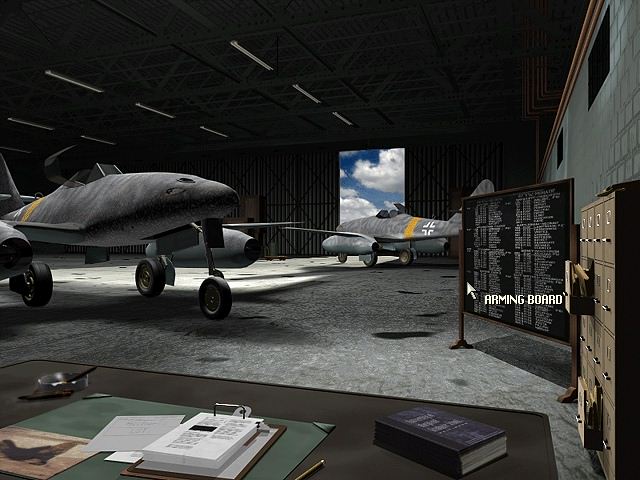
You begin each mission with a map briefing. The subtitles help if your high school German is rusty. If you have friends who are not sim freaks, they'll love this screen. Depending on the A/C, there is a variety of action with beautifully clear resolutions that look like a computer animated movie. Engines are tested, welding torches sparkle, controls surfaces are moved, and out the door other planes fly by. Once at the hanger you can change the roster or ordnance if your rank is high enough. Scores and number of missions flown by the squad's pilots are on a chalk board. Many of the last names are those of real aces with different first names, lending a familiar feel to it all. After take off, the "a" key kicks on autopilot to help you stay in formation. It's useful for take off and landing until you observe and learn your plane's characteristics. You hit ALT N to skip to the next encounter unless you want to just fly and enjoy the ride. The 8X time compression is great for closing long stretches, but mine seems to work infrequently at less than six miles. |
If you survive your mission, debrief lets you know how you faired. You win medals and are promoted. You then go to your barracks where you can check entries in your logbook, listen to the radio and look at your medals. I only wish the log book listed the types of A/C you destroyed. Outside vehicles drive by and hot shots make low passes over the field. There are multi-player functions that will link you up via LAN, the internet, or modem to modem. Odds are you'll have people to fly with somewhere. I'LL BE RIGHT THERE One thing most pilots will like is the pretty fair wing man. There are adequate commands to allow a wide spectrum of communications between you and you wingie, the squadron, the whole flight, and ground control. Your wingman will warn you about bandits on your six with loud commands to break. He'll tell you the direction of the bandit you are tracking too. In fact, the radio is realistically alive with voices- elated ones claiming kills; desperate ones in trouble or going down; calm ones of ground control and wing leaders issuing instructions. That "big sky" feeling hits you again when a squadron mate is calling for assistance and you can't see him.
I still find myself repeatedly calling my wingman for cover with mixed results, as in Aces Over Europe. There is an "anyone help" call that seems to be more urgent. It seems to bring aggressive, friendly fighters in faster. I just want my wingman to see me as God and shoot the bad guys off my butt right away. But this a minor complaint at best. KA-CHING! When you do get hit by enemy ordnance, the sound is lifelike. You hear metal being pierced for sure. A box of heavy bombers will make you think you are in a hail storm if you loiter too long. Now I can truly appreciate the 109 pilot, Mike Karatsonyi, who described to me tearing in, firing best he could, and egressing to keep ahead of the Mustangs. There are some excellent ricochets and thuds in the sound effects also. (No more cheezy synthesized tones to approximate things). Flight models seem comfortable. No new revelations for the experienced simmer. They fly well and there are noticeable differences between the individual A/C. Vices and virtues are modeled uniquely.... you be the judge as to how well. Diving is well modeled. At shallow angle you will pick up speed quickly. At steep angles you'll find maximum speed approaches alarmingly fast. It is a certainty that your A/C will be damaged, perhaps un-flyable, if you pull out too rapidly. The airframe will groan when put under stress in dives or other high G maneuvers too. Inertia is believable in all aspects such as a zoom climb. Your aircraft will glide well if you lose an engine. Bellying in is dicey and it's safer to hit the silk if you are over friendly territory. You can always replay the mission if you do badly.
Go to Part III
|
|||
|
© 1997 - 2000 COMBATSIM.COM, INC. All Rights Reserved. Last Updated November 22nd, 1998 |
||||