
|
Historical Article: Relentless In Battle
Posted by Donster on: 2014-05-24 11:06:06 in category: Military History [ Print ]
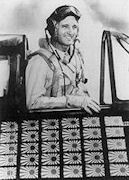
By Thomas McKelvey Cleaver, Aviation History Magazine
Hellcat pilot David McCampbell used his gunnery skills to achieve “ace in a day” status twice, earning the Medal of Honor and ultimately becoming the U.S. Navy’s ace of aces.
Read on...
News Source: Email
Historical Article: The Gurkhas: Britains Own Fiercely Fighting Foreign Legion
Posted by Donster on: 2014-05-19 16:34:12 in category: Military History [ Print ]
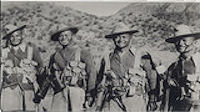
An overview of these famous soldiers exploits in WWII
By John Dudek @ The Wargamer
During the hard and bloody fighting in Italy in 1944, a story was told of an attacking German soldier who spotted an English-speaking Gurkha in a foxhole and lunged at him with his bayonet fixed rifle. The Gurkha twisted his body a little, just in time. "You missed me." he said, and then whipped out his razor sharp kukri knife and slashed at his neck. "You missed me, too!" said the German. "Hell I did!" said the Gurkha. "Wait until you shake your head."
Read on...
News Source: Email
Historical Article: From Tragedy to Triumph
Posted by Donster on: 2014-05-13 17:39:18 in category: Military History [ Print ]
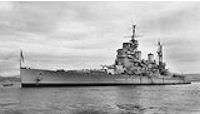
The British Pacific Fleet in WWII
By John Dudek @ The Wargamer
The first six months of WWII's War in the Pacific were a nightmarish time of endless, ever mounting losses and horrendous military defeats suffered by the ABDA (American, British, Dutch and Australian) Allies to the ever advancing, victorious Japanese Empire. To the victor went the spoils. The Dutch lost their priceless oil and gas rich colonies in the Dutch East Indies. The Americans lost an entire army of over 60,000 men, most of their Asiatic Fleet and all of the Philippine Islands, plus a number of their other island or colonial holdings as well. The British lost Hong Kong, all of Malaya and an army of over 130,000 men at Singapore. British Commonwealth Forces were also in the process of being forcibly ejected from their colony of Burma by the Japanese. The supreme insult however, was in the loss of the fortress of Singapore, the "Jewel in the British Far Eastern Colonial Crown."
News Source: Email
Wargaming and RAF Museum Announce Dornier 17 Final Resting Place
Posted by Donster on: 2014-05-13 17:39:04 in category: Military History [ Print ]

Wargaming has announced the Dornier Do17 aircraft’s final resting place at the Royal Air Force Museum in Cosford, Shropshire, United Kingdom upon completion of the restoration in 2015.
In 2013, Wargaming and the Royal Air Force Museum set out to restore the only known surviving Dornier Do17 aircraft and provide visitors with the opportunity to view the renovation process and learn more about its history and role throughout World War II. The exhibit currently features restored pieces of the plane and upon completion next year, the Dornier Do17 aircraft will be featured alongside the Wargaming.net Interpretation Zone.
Additionally, to celebrate the opening of the Wargaming.net Interpretation Zone on Feb. 28, Wargaming and the RAF Museum launched a mobile application, Apparition, using augmented reality to view a virtual version of the aircraft flying over the museum. Users were encouraged to submit photos of the hundreds of virtual Do17’s from around the world, and the top 15 photos from Australia, UK, Ukraine, Philippines, Mexico and the USA were chosen to be on display at the exhibit.
“Offering people around the world to participate in each step of the Dornier Do17 renovation process has been a truly gratifying experience,” said Tracy Spaight, Special Projects Director at Wargaming. “As a company heavily invested in the preservation of military history, we feel it’s important to show our gratitude and appreciation towards these unique relics.“
Click here for more information and video.
News Source: Email
Historical Article: Action off the Komandorski Islands, March 1943
Posted by Donster on: 2014-04-24 17:08:16 in category: Military History [ Print ]
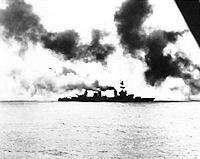
One of the last decisive daylight gunfire naval battles in history
By John Dudek @ The Wargamer
In the cold, predawn hours of 3 June 1942, dozens of Japanese Diahatsu landing craft made landfall along the wave tossed, rock strewn shore. Hundreds of armed, grim faced, Imperial Japanese infantry splashed through the chilly breaker waters in this, the first enemy invasion of sovereign US territory since the War of 1812. Their troops fanned out from the landing beaches, moving quickly inland to take possession of the nearly uninhabited island. This was but one of two scheduled Japanese amphibious invasion operations. As a result, the American islands of Attu and Kiska along Alaska's Aleutian most westerly chain of islands were now firmly in Japanese hands.
Read on...
News Source: Email
Russian Kubinka Tank Museum to Restore Maus Super-Heavy Tank with Wargaming
Posted by Donster on: 2014-04-22 18:22:31 in category: Military History [ Print ]
Wargaming today unveiled its plans to join with its long-term partner, the Russian Kubinka Tank Museum, to reconstruct and put back to a running condition the only remaining Panzer VIII Maus tank.
“Wargaming closely cooperates with military museums around the world,” said Andrei Yarantsau, VP of Publishing at Wargaming. “We are excited to contribute to the Kubinka’s initiative and plan on supporting the museum in future. We’ll help it put together an exclusive collection of armored warfare, assisting it in lifting and reconstruction of legendary military vehicles and enriching its exhibition with renowned machines from private collections from across the world. A unique selection of legendary warfare will attract military enthusiasts from Russia and abroad, sparking interest towards military history and inspiring younger generations to learn more about their country’s past.”
Regarded as the epitome of excellent tank design, the colossal Panzerkampfwagen VIII Maus is the heaviest, fully enclosed armored fighting vehicle to see completion during World War II. Weighing 188 tonnes, only two prototypes were ever completed. The sole surviving tank is housed at the Kubinka Museum with an empty hull.
The museum and Wargaming intend to re-build its interior from scratch based on authentic diagrams. Missing parts will be restored in single quantities at a number of tank-building plants, with the entire process supervised by experienced warfare instaurators. The conserved Maus will be stored at the Kubinka Museum so that people from all over the world may come see the renowned vehicle with their own eyes.
Wargaming is involved in a number of socially significant projects that aid in the preservation of historic heritage. The company has launched a global campaign to assist in the search for and conservation of military warfare worldwide, including the support of the Soviet T-34-76 tank restoration in Belarus and the lifting and reconstruction of the KV-1 USSR tank in Voronezh, Russia. Other activities include the recovery of the world’s last remaining Dornier Do 17, now on display at the Royal Air Force Museum in Cosford, United Kingdom, the Wargaming Education Center at the Tank Museum at Bovington, United Kingdom, and the on-going sponsorship of the USS Iowa, docked in the Port of Los Angeles, California.
News Source: Email
Historical Article: The Royce Raid
Posted by Donster on: 2014-04-09 17:46:51 in category: Military History [ Print ]
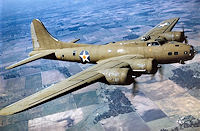
The USAAF fights back in early 1942
By John Dudek @ The Wargamer
The five B-25 Mitchell medium bombers, with bomb bay doors open, came in low and fast over the harbor at Cebu that morning at near wave top height, lining up on the three Japanese transport ships tied up along its pier. A quick toggle of bombs by the plane's bombardiers and all three transports were hit with one of them exploding and capsizing with a massive roar. Two quick attack passes was all it took for the docks and warehouses, plus some other ships to be hit, left burning or in ruin. The unexpected savagery, accuracy and quickness of the surprise bomber raid utterly shocked the confused Japanese. Surprise attacks were something that happened to other people, not the Japanese. How could this be? After all, the Philippines were now a peaceful, Japanese occupied rear area backwater of the war with no enemies left for over a thousand miles in any direction.
Read on...
News Source: Email
The Arab-Israeli War of 1973: Honor, Oil, and Blood
Posted by Donster on: 2014-03-18 16:03:15 in category: Military History [ Print ]
By O'Brien Browne @ Historynet.com
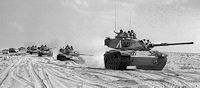
HEAT WAFTED UP IN SLEEPY SPIRALS from the Sinai Desert on the afternoon of October 6, 1973. Lizards lay about on sun-warmed stones, blinking in contentment. Falcons circled lazily in the pale blue sky. The waters of the Suez Canal lapped gently at its sandy shores. Suddenly, at exactly 2 p.m., this hushed stillness erupted as 2,000 Egyptian artillery pieces, Katyusha rockets, howitzers, and surface-to-surface missiles blasted the canal's eastern bank, throwing tremendous plumes of sand into the air. Israeli defensive positions years in the making were pulverized in minutes. Without warning, 222 Egyptian MiG and Sukhoi fighters came screaming out of the sky and bombed command posts, surface-to-air batteries, air bases, supply dumps, and radar installations. Simultaneously, a few hundred miles to the north, the rugged hills of the Golan Heights shook with massive explosions as 100 Syrian MiGs attacked Israeli positions and an assault force of as many as 900 tanks and 40,000 infantry crossed into Israeli territory.
Read on...
News Source: Email
Amazing But True Aviation Stories
Posted by Donster on: 2014-03-04 16:52:33 in category: Military History [ Print ]
By Stephan Wilkinson @ Historynet.com
These 10 aviation tales prove that sometimes truth really is stranger than fiction.
Read on...
News Source: Email
The Last Stand of the Fourth Marines - Corregidor May 1942
Posted by Donster on: 2014-02-18 16:53:35 in category: Military History [ Print ]
By John Dudek @ The Wargamer
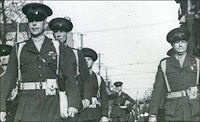
On May 6, 1942, a hellish and seemingly endless staccato drum roll beat of Japanese heavy artillery explosions blasted and smothered the US held Philippine island fortress of Corregidor in Manila Bay. In the communication's lateral of Corregidor's Malinta Tunnel, US Army radio man Corporal Irving Strobing pounded away on his telegraph key. He was speaking to his radio counterpart in far-off Hawaii. Concrete dust loosened by the Japanese artillery blast concussions sifted down from the ceiling above, or was stirred up from the concrete floor below. The tunnel's generator coughed and the lights momentarily dimmed for an instant, as a weary and hungry Strobing paused, then continued signaling:
"They are not yet near. We are waiting for God only knows what. How about a chocolate soda? Not many. Not here yet. Lots of heavy fighting going on. We've only got about one hour, twenty minutes before.... We may have to give up by noon. We don't know yet. They are throwing men and shells at us and we may not be able to stand it. They have been shelling us faster than you can count.... They bring in the wounded every minute. We will be waiting for you guys to help. This is the only thing I guess that can be done. General Wainwright is a right guy and we are willing to go on for him, but shells are dropping all night, faster than hell. Damage terrific. Too much for guys to take. Corregidor used to be a nice place, but its haunted now. Withstood a terrific pounding. Enemy heavy cross-shelling and bombing. They have got us all around and from skies. Men here all feeling bad, because of terrific nervous strain of the siege...”
Read on...
News Source: Email
Historical Article: Melvin the Giant Killer
Posted by Donster on: 2014-01-04 14:53:48 in category: Military History [ Print ]
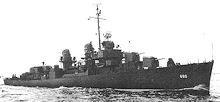
Destroyer USS MELVIN vs. Battleship IJN FUSO
By John Dudek @ The Wargamer
In the faint, quarter-moonlit wee hours of an otherwise pitch black 25 October, 1944 morning, the Japanese combined battleship and cruiser Task Force C and the US Navy destroyers of DESTROYER SQUADRON 54 quickly approached each other on opposing course headings, with a combined speed of well over 45 knots - like two run-away locomotives headed on a collision course on the very same track. Radar lookouts on two US destroyers, McDERMUT and MONSSEN, sighted the oncoming Japanese at a range of almost 15 miles at 0254 hours. The US destroyers in their two separate columns were ordered to make a smoke screen to hide their torpedo attack approach. The US destroyers rang up full speed as they started their torpedo attack runs. Their sterns dug deep into the ocean's trough of the Surigao Strait as their torpedo tube mounts swung out to track the oncoming Japanese task force. The torpedo crews anxiously awaited a planned crucial change of course turn to starboard that would give them the best possible torpedo firing solution for shooting at the rapidly oncoming Japanese ships. Two of the distant Japanese warships stood out over all the other ships of FORCE C. Both of these massive warships had distinctive, impressive and very high "pagoda masts" atop their forward superstructures. They were the veteran WWI era sister battleships, the IJN FUSO and the IJN YAMASHIRO.
Read on...
News Source: Email
The Second Naval Battle of Guadalcanal November 14-15, 1942
Posted by Donster on: 2013-10-17 16:50:01 in category: Military History [ Print ]
By John Dudek @ The Wargamer
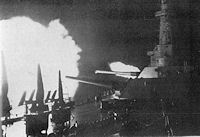
The Second Naval Battle of Guadalcanal represented the last major Japanese effort to wrest control of Guadalcanal back from the invading Americans. All further Japanese resistance ceased on February 9, 1943, with the final withdrawal of their remaining forces by ships of the Japanese Navy.
Read on...
News Source: Email
Ploesti - The Rest of the Story
Posted by Donster on: 2013-10-04 16:27:57 in category: Military History [ Print ]
By Barrett Tillman @ HistoryNet.com
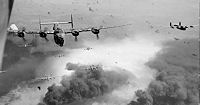
In April 1944, the Fifteenth Air Force had begun a four-month campaign to destroy the petroleum refineries around Ploesti. In fact, the Fifteenth was all about oil at that point: Since Romania lay 1,300 miles from the English bases of the Eighth Air Force, Lt. Gen. Nathan Twining's command had been established on fields surrounding Foggia, on Italy's east coast—well within reach of the refineries.
Read on...
News Source: Email
Air Cav: How Soldiers in the Sky Reshaped Combat on the Ground
Posted by Donster on: 2013-09-06 16:08:34 in category: Military History [ Print ]
By Joseph Abodeely @ HistoryNet.com
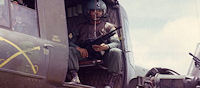
One of the great battlefield innovations developed by the United States armed forces in its effort to defeat a skilled and often elusive enemy in Vietnam was air cavalry—light infantry deployed by helicopters. While swift-moving aircraft supplanted horse or mechanized ground transport, the theory of rapid deployment of light infantry remained the same. The infantry's mission is to close with the enemy by means of fire and maneuver to defeat or capture him, or to repel his assault by fire, close combat and counterattack. Only close combat between ground forces gains the decision in battle. Whether on foot, horse or vehicle, parachuting from an aircraft, or jumping from a helicopter, the infantry must maneuver as part of its mission. At all levels of war, successful maneuver requires agility of thought, plans, operations and organizations.
Read on...
News Source: Email
The Battle of Tsushima - 8 February 1904
Posted by Donster on: 2013-08-08 17:20:49 in category: Military History [ Print ]
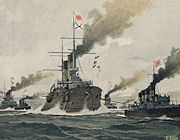
By Kristian Fischer @ The Wargamer
The Russo-Japanese war of 1904 to 1905 was a historical inevitability. It grew out of the friction between Japan, which had transformed itself into a new, modern nation in less than half a century and now wished to be recognised as such on the international stage, and Russia, a gigantic and old empire that wished to secure holdings and influence for itself on the Pacific coast.
The attack was launched on the night of 8 February 1904, when a Japanese destroyer squadron infiltrated the crowded roads and torpedoed Russian battleships Tsesarevich and Retvizan and the cruiser Pallada. No ships were sunk on either side, and the attack must generally be considered to have been ineffectual. The troop landings at Chemulpo achieved success without interference from Russian ships, however. By April, the Japanese army was ready to cross the Yalu river into Manchuria.
Read on...
News Source: Email
The Battle of Edsons Bloody Ridge - Guadalcanal September, 1942
Posted by Donster on: 2013-08-02 17:47:33 in category: Military History [ Print ]
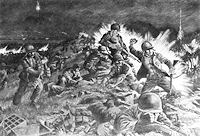
By John Dudek @ The Wargamer
Perhaps the most savage and bloody, yet largely uncelebrated or remembered, military campaigns in the Pacific War between the US and Japan, revolved around the steamy, tropical Island of Guadalcanal in the Solomon Islands chain. For well over six months the marines, army, naval and air forces of the Japanese Empire and the United States were locked in a bitter struggle of unending mortal combat on land, sea and in the air. At the battle’s conclusion, the two tottering combatants were left standing toe to toe like two bloodied, bruised and exhausted, punch-drunk fighters in a boxing ring, still throwing bludgeoning haymaker punches at the other until only one was left standing. This was the battle that broke the back of Japanese aviation in the Pacific leading to the first truly resounding Japanese defeat of their combined arms, to be followed by an unending series of defeats leading to their eventual surrender at Tokyo Bay in 1945.
Read on...
News Source: Email
Death by P-38
Posted by Donster on: 2013-06-07 15:01:39 in category: Military History [ Print ]
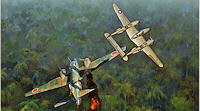
By Don Hollway @ HistoryNet.com
That Saturday afternoon the "Opium Den"—the smoky, sweltering, ramshackle command bunker at Henderson Field, on Guadalcanal—was packed with Navy and Marine brass hats. Lowly flyboys Captain Thomas Lanphier Jr. and Major John W. Mitchell, commanding officer of the U.S. Army Air Forces' 339th Fighter Squadron, arrived last, but were treated like guests of honor. Mitchell was handed a teletyped radio message marked "Top Secret": a flight schedule for an inspection tour by Japanese Admiral Isoroku Yamamoto.
Read on...
News Source: Email
Book Review: Fighter Group
Posted by Admin on: 2013-04-08 19:55:22 in category: Military History [ Print ]
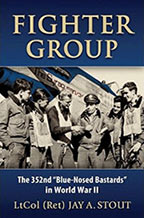
LtCol (Ret) Jay A. Stout's latest book is a work of narrative journalism that reveals not only the glamorous aspects of life lived by American USAAF fighter pilots tasked with escorting B-17 and B-24 bombers, but also the mundane, awkward, hilarious, tragic and even despicable aspects as well.
It is a colourful, compelling, and above all, very human account of these young mens' lives.
News Source: In-House
Ridgway: Iron Man at the Front
Posted by Donster on: 2013-03-05 15:38:05 in category: Military History [ Print ]
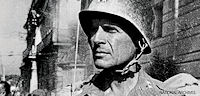
By Carlo D'Este @ Historynet.com
Acts of great courage in war aren't limited to the battlefield. One little-known incident during World War II defined Major General Matthew B. Ridgway as a commander of unrivaled courage when he laid his career on the line at a critical moment.
Read on...
News Source: Email
The USS Scorpion Buried at Sea
Posted by Donster on: 2013-02-15 15:44:24 in category: Military History [ Print ]
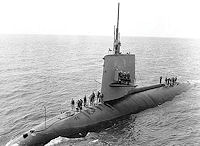
By Ed Offley @ Historynet.com
Did U.S. and Soviet navy officials deep-six the real reason the American nuclear attack submarine Scorpion sank with 99 sailors aboard?
The crisis exploded without warning across the sprawling U.S. Navy community in Norfolk, Virginia: A nuclear submarine and its crew had vanished in the Atlantic. On May 27, 1968, USS Scorpion (SSN 598) failed to return as scheduled to its home port at the destroyer-submarine pier complex at the southern end of the waterfront.
Read on...
News Source: Email
P-51 Pilot: A Day in the Life
Posted by Donster on: 2013-01-17 16:12:44 in category: Military History [ Print ]
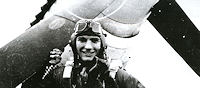
A Mustang jockey recounts one of his most memorable missions—from start to finish.
By William Lyons @ Historynet.com
"You're on tomorrow," Captain John Poyen, 357th Squadron intelligence officer, tells me the day before the mission. It's November 25, 1944, and I'm a 20-year-old first lieutenant P-51 pilot from Brooklyn, New York, assigned to the 357th Squadron, 355th Fighter Group, Eighth Air Force, and based at Station 122, in Steeple Morden, England.
Read on...
News Source: Email
From D-Day to Paris: The Story of a Lifetime
Posted by Donster on: 2012-05-14 16:46:24 in category: Military History [ Print ]
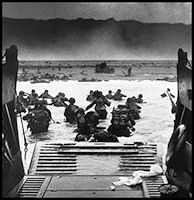
Three legendary war correspondents — Robert Capa, Ernie Pyle, and Ernest Hemingway — scramble to cover the Allied advance across France
By Alex Kershaw @ HISTORYnet.com
Loudspeakers blared: "Fight to get your troops ashore…. If you've got any strength left, fight to save yourselves…. Away all boats!…. Our Father, who art in Heaven, hallowed be thy name…." At 5:50 a.m., the battleships Texas and Arkansas opened up. In Life photographer Robert Capa's landing craft, which was nearing Omaha Beach, some men were bailing water frantically with their helmets. Others looked up at the heavy salvos flying over their heads and cheered.
Read on...
News Source: Email
Life and Death on a Long Range Recon Patrol
Posted by Donster on: 2011-09-12 17:47:55 in category: Military History [ Print ]
By Tom Corpora @ HistoryNet.com
When the formation of helicopters—a command and control chopper, two gunships, and the insertion and chase ships—neared its destination where Vietnam's Highway 19 crosses into Cambodia, the insertion and chase ships dropped from the formation and began an elaborate pas de deux of deception. With the gunships covering them, the insertion ship dropped into a clearing and hovered a moment, faking an insertion, while the chase ship roared past. Then the insertion ship rose suddenly and fell in behind the chase ship, which dropped into the next clearing to fake an insertion while the insertion ship flew past. The two helicopters performed this leapfrogging dance four times before the insertion chopper finally dropped its payload—four heavily camouflaged soldiers from the Long Range Reconnaissance Platoon (LRRP) of the 4th Infantry Division's 2nd Brigade.
Read on...
News Source: Email
March 30 – Welcome Home Vietnam Veterans Day
Posted by Donster on: 2011-03-21 15:59:19 in category: Military History [ Print ]

By Armchair General Staff
On March 30, 1973, all U.S. troops withdrew from Vietnam. There were no ticker-tape parades honoring the veterans, no triumphant marches or speeches as there at been at the end of each of the World Wars. America’s Vietnam veterans returned home to silence, or worse, in some cases to denigration for having served their country during a controversial war.
March 30, 2011, has been officially designated "Welcome Home Vietnam Veterans Day."
The U.S. Senate resolution designating the day as one to provide overdue honor to the members of the armed services was introduced by Senator Richard Burr (R–North Carolina), Ranking Member of the Senate Committee on Veterans Affairs. This is the second consecutive year he has introduced such a resolution.
On March 30, make a special effort to say, "Welcome home."
Read on...
"Welcome home Old Guy ...Welcome home."
Donster
News Source: Email
France Invades North America in World War II
Posted by Donster on: 2011-03-09 15:32:55 in category: Military History [ Print ]
By Stefen Styrsky @ Armchair General
World War Two evokes images of military forces clashing on a massive, if not continental scale: the D-Day invasion, Leyte Gulf, the North Africa Campaign come immediately to mind in any discussion of the conflict’s battles. Most are also imagined occurring outside the Western Hemisphere. Yet there was action, less expansive events, in other places—even North America.
One such incident was the invasion of two islands off the coast of Canada’s Newfoundland by the Free French. Despite its minor nature compared to what was happening elsewhere, the incident caused a serious rupture among the Allies and threatened an important agreement the United States possessed with Vichy France. It had the potential to dramatically alter the course of war.
Read on...
News Source: Email
USS Robin – The Victorious U.S. Carrier that Didn’t Exist
Posted by Donster on: 2011-03-03 17:47:14 in category: Military History [ Print ]
By Joseph Tremain @ Armchair General
It is not unusual for a ship to disappear at sea in wartime—but for a ship as a large as an aircraft carrier to suddenly appear from nowhere is noteworthy to say the least. That is exactly what it must have looked like to Japanese naval intelligence officers listening to American transmissions in the Pacific in early 1943.
This story begins in late 1942 when the United States Navy found itself in a precarious situation in the war with the Japanese Empire. At the Battle of the Santa Cruz Islands, the aircraft carrier USS Hornet was sunk and the USS Enterprise was severely damaged, temporarily putting it out of action. That left the USN with only one fleet carrier to carry on the South Pacific campaign in the Solomons. But in May of 1943, during Operation Cartwheel, which was intended to isolate and neutralize the Japanese base on Rabaul, a second fleet carrier suddenly appeared beside the only remaining operational US carrier, the USS Saratoga, which operated out of Noumea, New Caledonia. This new fleet carrier was being called the USS Robin, but it was not listed in the USN inventory, and it couldn’t be The USS Essex, which was nowhere near completion. Yet there she was—a full-sized fleet carrier complete with American Avengers and Wildcats on her deck. This mystery carrier, the USS Robin, might have become famous if it had taken part in any major fleet battle, but instead it has faded from all but the more detailed history books.
Read on...
News Source: Email
Erwin Rommel – Roots of Victory, Seeds of Defeat
Posted by Donster on: 2011-02-14 16:29:34 in category: Military History [ Print ]
By Douglas Sterling @ Armchair General
He was “the perfect fighting animal,” a man extolled in his own time as a military genius, even by his enemies. Of unquestionable courage and drive, of military dash and elan, he lived by his belief in the importance of direct command, of continuous movement and maneuver, of boldness to the point of rashness. Such was Field Marshal Erwin Rommel, whom history and awed opponents mythologized as the “Desert Fox.”
Read on...
News Source: Email
Vietnam Journal - Don Lomax Interview
Posted by Donster on: 2011-01-20 16:46:25 in category: Military History [ Print ]
By Gerald D. Swick @ HistoryNet.com
Don Lomax is a 35-year-plus veteran of the competitive world of comic and cartoon artists. He is also a veteran of a much tougher struggle—the Vietnam War. Drafted in 1965, the following year he found himself serving in Vietnam with the 98th Light Equipment Company. Notes and sketches he made during his time there led him to create a critically acclaimed "comic," the graphic novel series Vietnam Journal, many years later. His words and artwork were literary napalm that burned away the sanitized versions of combat and soldiering found in traditional "war comics." The images are often violent, the characters' language at times profane; we asked for some of his tamer pages to run with this article.
Vietnam Journal garnered praise from Military Book Club, Publishers Weekly and numerous other sources, but it went out of print. Twice. Now the stories are being collected into graphic novel format and made available to readers again through Tranfuzion Publishing. HistoryNet's editor Gerald Swick recently interviewed Don Lomax about his work, his children—two sons have served in the military, one of whom is still on active duty—and what led him to break traditional comic-book boundaries and present a more realistic war comic.
Read on...
News Source: Email
Mr. Stewart Goes to War
Posted by Donster on: 2011-01-17 17:18:52 in category: Military History [ Print ]
By Richard L. Hayes @ HistoryNet.com
His paternal grandfather had fought against the South, and his father against Spain and Germany, so it was reasonable to assume James Maitland Stewart would serve in his turn. By the late 1930s, his career was just taking off with such hits as You Can't Take It With You, Mr. Smith Goes to Washington and Destry Rides Again. But with war looking inevitable, Stewart set his sights on a new role, this time in the U.S. Army Air Corps. He even bought his own plane, a Stinson 105, eventually graduating to multi-engine aircraft and earning a commercial pilot's license, all on his own.
Read on...
News Source: Email
The Men Who Killed The Luftwaffe
Posted by Admin on: 2010-12-13 16:43:44 in category: Military History [ Print ]
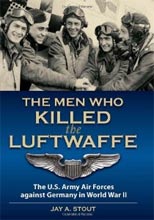
Jay A. Stout, former F/A-18 fighter pilot and author of Hornets over Kuwait and several other books about combat aviation, has a new offering called The Men Who Killed the Luftwaffe: The U.S. Army Air Forces against Germany in World War II.
If you have even a passing interest in the air war over Europe and North Africa in WWII, then you will want to check out this review. Author Stout combines his extensive research into the evolution of the USAAF from its earliest, tentative beginnings and eventual maturation into the world's deadliest air force with dozens of incredible, gut-wrenching, and often tragic first-hand accounts of the men who flew the missions.
Link: Read the review.
News Source: COMBATSIM.COM
10 Battles That Shaped America
Posted by Donster on: 2010-11-08 17:00:05 in category: Military History [ Print ]
By Thomas Fleming @ HistoryNet.com
Over the course of its history the United States military has engaged in many crucial and decisive battles. A few were truly tipping points that shaped wars' outcomes, peace, the national identity—and even literally shaped America. Any such selection is open to debate and interpretation. But the battles cited here have certainly helped create and define America. Indeed, had these battles ended differently, the United States would today be a far different nation.
Read on...
News Source: Email
Yanks in the Royal Air Force
Posted by Donster on: 2010-10-14 16:20:49 in category: Military History [ Print ]
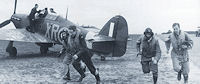
By Alexander Kershaw @ HistoryNet.com
In the summer of 1940 the Second World War had been under way for nearly a year. Hitler's Germany was triumphant. The United States was neutral. It was a time, Winston Churchill later observed, when "the British people held the fort alone till those who hitherto had been half blind were half ready." Some Americans, however, did not remain on the sidelines.
That summer and fall, eight American pilots fought against the Nazis in the Battle of Britain. This remarkable bunch of rogue flyers included ex-barnstormers, a Minnesota farm boy, and the greatest bobsled champion in American Olympic history. All had defied strict neutrality laws—thereby risking loss of their citizenship and imprisonment if they dared return home—in order to join what they regarded as the best flying club in the world: Britain's Royal Air Force.
Read on...
News Source: Email
Creating Chaos: Lawrence of Arabia and the 1916 Arab Revolt
Posted by Donster on: 2010-09-01 17:25:51 in category: Military History [ Print ]
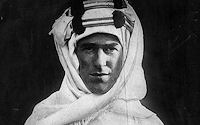
The British-backed Arab Revolt–featuring Lawrence of Arabia–planted the seeds of conflict in the Middle East
By O'Brien Browne @ HistoryNet.com
The train filled with Ottoman Empire soldiers and civilians chugged over a bridge in the Arabian desert. A few yards away a British officer in Bedouin robes raised his hand toward Salem, an Arab tribal warrior gripping the plunger of a detonator box. As the train steamed ahead, the officer dropped his hand and Salem slammed down the plunger. A cloud of sand and smoke blasted a hundred feet into the sky as sizzling chunks of iron and seared body parts tumbled through the air. The train crashed into a gorge, followed by an eerie silence. The officer and Arab tribesmen—wielding swords or firing rifles—dashed toward the smoldering train cars. Within a few minutes the fighting was over, the dead and the wreck were looted, and the raiding party melted back into the desert. It was summer 1917, and the Arab Revolt was in full swing.
Read on...
News Source: Email
Khe Sanh and Beyond: Col. (ret) Joseph Abodeely Interview
Posted by Donster on: 2010-08-31 16:46:24 in category: Military History [ Print ]
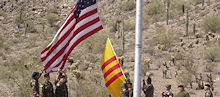
By Gerald D. Swick @ HistoryNet.com
Retired Army Colonel Joseph Abodeely's Website, Straight Talk with Joe, describes him as "a native Arizonan who has some strong opinions and ideas about his state, the nation, and the world." Many of those opinions were forged in combat, both in the military and in the courtroom.
During Operation Pegasus, the April 1968 airmobile operation to relieve the besieged U.S. Marine firebase at Khe Sanh, South Vietnam, he led the first Air Cavalry platoon that reached the firebase, after seven days fighting its way through.
Since that time he's served in the Judge Advocate General's Corps and written policy papers that provided guidelines for U.S. military police worldwide. As a civilian, he's been a prosecuting attorney and a defense attorney. In addition to his Website, he had a radio talk show and a program on Phoenix Public Access Channel 98 for over 10 years.
Of Lebanese descent, he's a past president of the Arab American Cultural Association in Phoenix. For many years, he's served as president of the board for the Arizona Military Museum, an all-volunteer group dedicated to preserving the area's military heritage from the days of the Spanish Conquistadores to the present-day wars in Iraq and Afghanistan. On August 19, 2010, the retired colonel spoke with HistoryNet in an exclusive interview.
Read on...
News Source: Email
Breaking the Siege at Khe Sanh
Posted by Donster on: 2010-08-30 17:23:20 in category: Military History [ Print ]
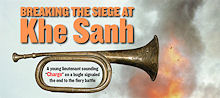
A young 1st Air Cav lieutenant signaled the end to one of the war's most storied battles with a blast of "Charge" on a captured bugle
By Joseph E. Abodeely @ HistoryNet.com
"Joegy," I recall my grandpa saying after he'd had a few beers, "Your two best friends are your rifle and your horse. And if you got just a little bit of water left in your canteen, give it to your horse first." Grandpa was a sergeant in the 1st Cavalry in 1917 and he was deployed along the Arizona border during Brigadier General John Pershing's Mexican Punitive Expedition against the revolutionary Pancho Villa. He knew the value of the horse and rifle to the cavalry soldier.
Fifty years after my Grandpa learned the lessons of mobility from atop his horse, I found myself an infantry lieutenant with the 1st Cavalry Division (Airmobile), the "1st Air Cav," in Vietnam. It was a new concept for the Army, swift deployment of light infantry troops, their artillery fire support, supplies and equipment—primarily by helicopter. We had mobility and firepower that the other Army units simply did not have.
Read on...
News Source: Email
Book Review: The War That Came Early
Posted by Donster on: 2010-08-11 17:37:18 in category: Military History [ Print ]
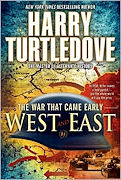
This work of alternative historical fiction may be part of The War That Came Early series, but our reviewer couldn't finish it fast enough.
Reviewed by: Avery Abernethy @ The Wargamer
The War That Came Early: West and East is the sequel to Hitler’sWar. The premise of this alternate history is the inability of Hitler to obtain the Sudetenland in a political deal with Chamberlain and other Western leaders. This causes WWII to start in 1938 with a Nazi invasion of Czechoslovakia.
Read on...
News Source: Email
Book Preview - Hero Found: The Greatest POW Escape of the Vietnam War
Posted by Donster on: 2010-07-20 16:49:58 in category: Military History [ Print ]
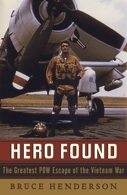
Dieter Dengler's Great Escape from Laotian POW Camp
Book by Bruce Henderson, Excerpt hosted by HistoryNet
On February 1, 1966, German-born U.S. Navy pilot Lieutenant (j.g.) Dieter Dengler's A-1 Skyraider was shot down over Laos during a secret bombing mission. A day later, while attempting to signal rescuers flying above heavy jungle territory controlled by the Pathet Lao and North Vietnamese Army regulars, Dengler was captured. After he was marched over several days from village to village—managing to escape once before being recaptured—he was finally imprisoned in a jungle-shrouded POW camp guarded by Pathet Lao on February 14. Six other prisoners were already there: Air Force 1st Lt. Duane Martin, a rescue helicopter pilot shot down in September 1965; another American, Eugene "Gene" DeBruin, an Air America crewman who had bailed out of a burning cargo plane in September 1963; and four other Air America crewmen from the flight, Thai civilians Prasit Promsuwan, Prasit Thanee and Phisit Intharathat, and To Yick Chiu, a Hong Kong native the men called Y.C.
Dengler, who had learned survival skills as a youth in wartime and postwar Germany and who was a Navy legend for his extraordinary escape and evasion skills, immediately began planning an escape. Some four months later, after being relocated to another camp and following meticulous preparation, Dengler and the others were ready, targeting July 4 for their mass escape. In mid-June, however, after the prisoners overheard the guards planning to kill all of them and return to their villages because a drought had caused a severe shortage of food and water, the POWs decided they could not wait any longer to make their breakout.
Read on...
News Source: Email
Watson's Whizzers - Saving the Me262
Posted by Donster on: 2010-05-26 17:45:17 in category: Military History [ Print ]
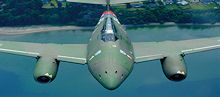
After Germany's surrender, U.S. pilots and mechanics under Colonel Harold Watson successfully returned 10 surviving Me-262s to the air
By Phil Scott @ History Net
Late in World II, Lieutenant Robert Anspach was flying cover in his P-47 Thunderbolt for a group of B-26 Marauders near the Messerschmitt factory airfield at Lechfeld, Germany. From out of nowhere an enemy airplane suddenly rocketed past, blasting off a few rounds. It looked like nothing the Americans had seen before. Ever.
Wow, thought Anspach.
"Would you look at him!" one pilot exclaimed over the radio.
"Let's go get him," another said.
By that time, he was gone. That was Anspach's introduction to the Me-262.
Read on...
News Source: Email
Screenwriter Bruce C. McKenna Talks About 'The Pacific' Miniseries
Posted by Donster on: 2010-03-29 17:24:49 in category: Military History [ Print ]
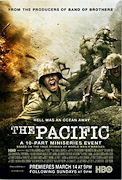
By Gerald D. Swick @ HistoryNet
After Bruce C. McKenna wrote part of the HBO Band of Brothers miniseries, his writing career in Hollywood soared. His "Bastogne" episode won a Writers Guild Award and was a finalist for the Hamanitas Prize. In 2003, Steven Spielberg and Tom Hanks hired him to research and oversee the writing of a new epic miniseries, The Pacific, which debuts Sunday, March 14, at 9:00 p.m. Eastern Time on HBO.
With wife Maureen, McKenna also produced off and off-off Broadway plays. On March 9, he talked with HistoryNet in an exclusive interview about his career and especially his work on The Pacific.
Read on...
News Source: Email
LeMay’s Dream Bomber - North American Aviation’s XB-70 Valkyrie
Posted by Donster on: 2009-12-31 16:28:44 in category: Military History [ Print ]
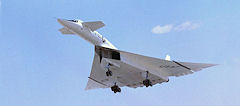
‘The XB-70 fulfilled General Curtis E. LeMay’s dream of a bomber that could penetrate the Soviet Union with impunity, carrying enough ordnance to decide the outcome of a war in a single strike’
By Walter J. Boyne @ HistoryNet.com
The magnificent 500,000-pound Valkyrie could cruise at Mach 3. It had monumental firepower, wingtips that folded down to enhance its exotic lines, and—best of all—a shape that did the impossible: obtain something for nothing from the air. North American Aviation’s XB-70 fulfilled General Curtis E. LeMay’s dream of a bomber that could penetrate the Soviet Union with impunity, carrying enough ordnance to decide the outcome of a war in a single strike. To the public, the Valkyrie represented the epitome of American aeronautical genius, and so it was. Yet the XB-70 took years to conceive, design and build. It was fatally compromised by a declining defense budget and the advent of improved surface-to-air and intercontinental ballistic missiles.
Read on...
News Source: Email
Tuskegee Airmen to be in Rose Bowl Parade
Posted by Donster on: 2009-12-31 16:16:25 in category: Military History [ Print ]
By Gerald D. Swick @ HistoryNet.com
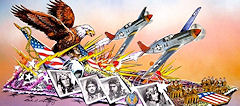
History buffs have something special to watch for in the New Year’s Day 2010 Tournament of Roses Parade prior to the 96th Rose Bowl football game. The theme for the event this time around is "A Cut Above the Rest." The City of West Corvina, a Los Angeles suburb, decided to use that to honor the Tuskegee Airmen of World War II. The parade begins at 8:00 a.m. Pacific Time, 11:00 a.m. Eastern.
Chris Freeland, deputy city manager for the City of West Corvina and volunteer executive vice-president of the West Corvina Rose Float Foundation, said, "This year we wanted to recognize the military, to have a military-themed float. As we did research into units in this area, we discovered that Los Angeles has one of the largest chapters of the Tuskegee Airmen Organization."
Sixteen surviving members of the World War II group will be riding on the float in the parade.
Read more...
News Source: Email
Axis Sally: The Americans Behind That Alluring Voice
Posted by Donster on: 2009-12-30 17:26:53 in category: Military History [ Print ]
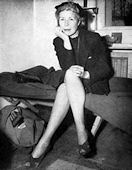
‘Well, kids, you know I’d like to say to you, "Pack up Your Troubles in Your Old Kit Bag," but I know that that little old kit bag is much too small to hold all the trouble you kids have got.’ —Axis Sally
By Richard Lucas @ HistoryNet.com
From the deserts of North Africa to the Normandy beaches, GIs listened to the sensual voice of an American woman broadcasting over the radio for Nazi Germany. The voice, alternately seductive and condemning, wondered aloud if their wives and girlfriends were “running around” with the 4-Fs back home, and gently pointed out the benefits of surrender. As the men tried to imagine the mysterious beauty behind the microphone, the swing music she played kept them tuning in. She cultivated a persona of worldly allure, ready to welcome the boys and understand their troubles.
The reality behind the voice was less glamorous. Two American women competed for the soldiers’ fantasies: Mildred Gillars, a middle-aged former showgirl from Ohio, broadcast from Berlin; the other, a cross-eyed 30-year-old New Yorker with a honeyed voice named Rita Zucca, broadcast from Rome. One was the willing mouthpiece of her mentor and lover, while the other collaborated with the Nazis for financial gain. But both women became enmeshed in the collective memory of American soldiers and sailors as one indelible figure: Axis Sally.
Read on...
News Source: Email
Bob Hope’s Vietnam Christmas Tours
Posted by Donster on: 2009-12-23 16:50:07 in category: Military History [ Print ]
By Judith Johnson @ HistoryNet.com
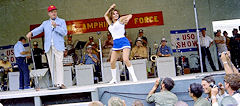
One of the few constants of the Vietnam War—one eagerly anticipated by American troops, that is—was the annual Bob Hope Christmas Show. From 1964 to 1972, Hope included South Vietnam on his annual trips to visit troops during the holiday season, a tradition that started for him during World War II. “Back in 1941, at March Field, California…I still remember fondly that first soldier audience,” Hope once said. “I looked at them, they laughed at me, and it was love at first sight.”
While only a small fraction of the 2.5 million troops who served in Southeast Asia actually got to attend Hope’s performances, for those who did he managed to break the monotony, ease the loneliness and give the troops in combat zones across Vietnam a couple of hours of laughter—and a memory for a lifetime. Bob Hope’s classic opening monologues of rapid-fire jokes always took jabs at the GIs and the specifics of the local situation.
Read on...
News Source: Email
Live from Washington, It’s Lottery Night 1969!
Posted by Donster on: 2009-12-23 16:44:56 in category: Military History [ Print ]
By Wesley Abney @ HistoryNet.com
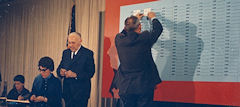
Forty years ago, on the evening of December 1, 1969, CBS News pre-empted the regularly scheduled broadcast of Mayberry RFD to pick up a live feed from Washington correspondent Roger Mudd at the Selective Service headquarters. “Good evening…Tonight for the first time in 27 years the United States has again started a draft lottery,” said Mudd in whispered tones as the ceremony proceeded in the background.
For all its life-changing, big-moment drama, as theater the drawing for the 1970 draft was a low-budget affair, staged on a nondescript set with an odd assortment of office furnishings pushed together. All 366 blue plastic lottery “capsules” had been unceremoniously dumped into a large glass container perched precariously atop a plain library step stool. A somber-looking official sat at a small table cloaked with black fabric, ready for the lottery ceremony to begin. To pick each lottery number, someone would simply reach into the water cooler–sized jar to pull out a capsule. Tucked inside was a birth date that would be read aloud and assigned its lottery number, starting with No. 001.
Read on...