
|
Destroyer Command Interview
by Leonard "Viking1" Hjalmarson |
||||
|
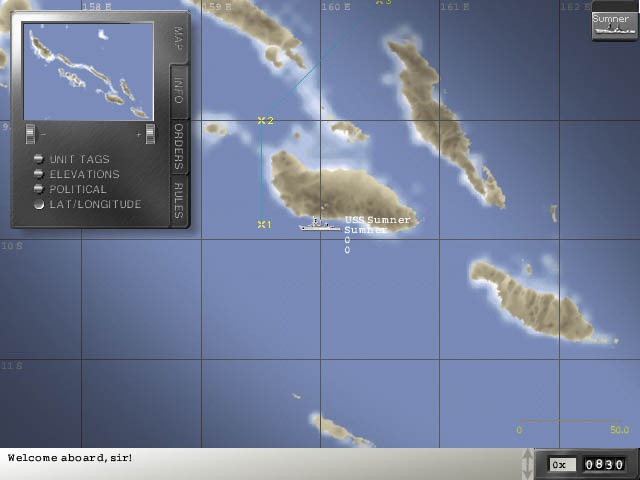
Q: One of the tactical elements present here that we haven't seen in a simulation like this before is rules of engagement. How do these work? Troy: ROE is basically a set of rules for the AI to follow when making decisions. We wanted to deal with the case of the player who wants to both command a division or squadron, but also work the systems on his own ship. To do this, we needed a mechanism to allow the player to communicate his intentions to the AI units under his command without requiring him to micromanage their actions. The great flaw with most real-time strategy games is, for me, the need for the player to divide his attention between several different processes (usually resource management and combat.) This prevents the game from having a lot of depth in any process and makes play-balancing the whole a real nightmare. We emphatically didn't want this to happen with DC, so we came up with the ROE concept. In a nutshell, ROE allows the player to tell the AI what types of targets it should prefer, what its operational objectives are and how much initiative it has in pursuing those objectives. The player can then point his ships in a given direction (or keep them in formation with his flagship) and expect the AI to behave within the guidelines he has set.
 Q: Do morale and fatigue factor in the efficiency of my division? Troy: This is an issue that's come up, but hasn't really been addressed in detail yet. Our current thinking is that it should be based on a system where the player controls the alert status of his ships. A ship at general quarters will naturally fatigue over time, but will be able to respond more quickly to threats. |
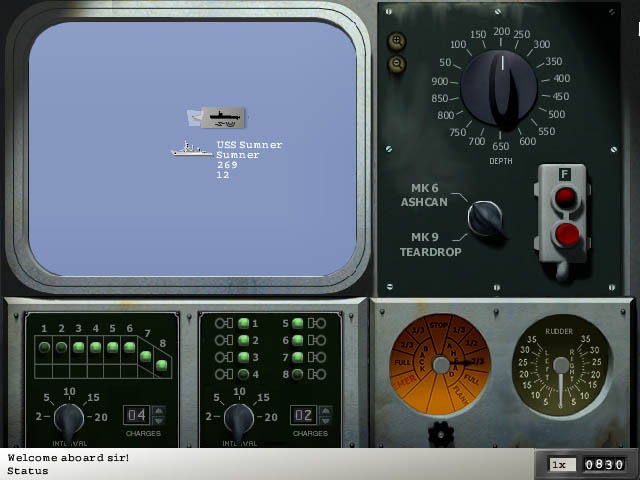 Q: One of the attractive things about this simulation is that destroyers perform so many kinds of duty. I saw you make contact with a submarine and then go to the depth charge station and configure a spread and then let them go. Tell us about this weapon system from the technical perspective. What is modeled, how much control does the player have, and what aspects can be automated? Troy: We've gone to a great deal of effort to simulate all of the weapons systems in detail, including depth charges, torpedoes, AA machine guns and, of course, the main battery. With depth charges, we wanted to give the player the ability to configure a pattern with maximum flexibility. To that end, we've provided controls to set the number of charges in the pattern, the interval at which they are dropped and the depth at which they detonate. In addition, the number of charges and drop interval may be set independently for the racks and the throwers (throwers, or "k-guns" are designed to hurl depth charges to port and starboard, allowing the ship to drop a much wider spread of depth charges.) Our goal was to provide an interface to something that was normally handled by a lot of men working in concert according to their training. This challenge arose repeatedly in the design of DC--particularly with the weapons systems which were normally crewed by teams of men. For example, a single AA mount has a pointer, a trainer, a mount captain and several ammunition handlers. Another example is the main battery director, which is crewed by about six men, with a whole second group of men manning the computer and the stable element. Naturally, we were forced to abstract a lot of the functions because a single human couldn't possibly control all of these aspects in a completely realistic model. We think we've done a pretty good job of suggesting realistic functionality without overburdening players. Go to Part III.
|
|||
|
Copyright © 1997 - 2000 COMBATSIM.COM, INC. All Rights Reserved. Last Updated November 9th, 1999 |
||||