
|
Destroyer Command Interview
by Leonard "Viking1" Hjalmarson |
||||
|
This interview is with Troy Heere, Director of Engineering for Ultimation, Inc. Troy is Designer and Lead Engineer for Destroyer Command, one of the simulations in the historical element of SSI's Digital Combat Series. Q: Can you tell us where you gained your interest in historical naval combat? Troy: World War II has always been of great interest to me. My grandfather and both of his brothers fought in the war, though they never talked about it. As a gamer, some of my favorite games were set in that conflict, including the flight simulators created by Lucas Arts years ago. While finishing Panzer Commander for SSI, I picked up a copy of Morison's The Two Ocean War and read it cover to cover after they expressed an interest in a destroyer game. I couldn't put it down! The battles of the Pacific theater in particular captured my imagination-- the sheer terror of those night battles, the grueling watches and horrifying kamikaze attacks. The men who fought that war have my deepest respect. Q: After looking at Destroyer Command I have to say I am pretty excited about this title. It reminds me of a high res and tactically enhanced version of Task Force 1942, the Microprose game released back in 1992. But DC allows much greater player involvement, and in fact shares more in common with Silent Hunter II than with Task Force. Unlike Fighting Steel, this is a true simulation rather than a strategy game. DC takes place primarily on the first person and tactical level. Also unlike Fighting Steel, DC has a very immersive environment graphically, including clouds and weather and sea states. Aren't you worried that some people are going to go out on this rolling deck and beeline for the nearest head? Troy: If they do then I think we will have succeeded! We've been considering including a package of dramamine in every box... But seriously, Destroyer Commmand is intentionally modeled more after Silent Hunter than any of the higher-level tactical simulations like TF1942 or Great Naval Battles. We felt that the focus on destroyers dictated a more immersive approach. At the same time a solid command and control interface was also necessary if we were to have division and squadron-level operations. So DC is really kind of a hybrid, with the CIC interface providing the tactical control and the other stations providing the nuts and bolts "simulation" interface. |
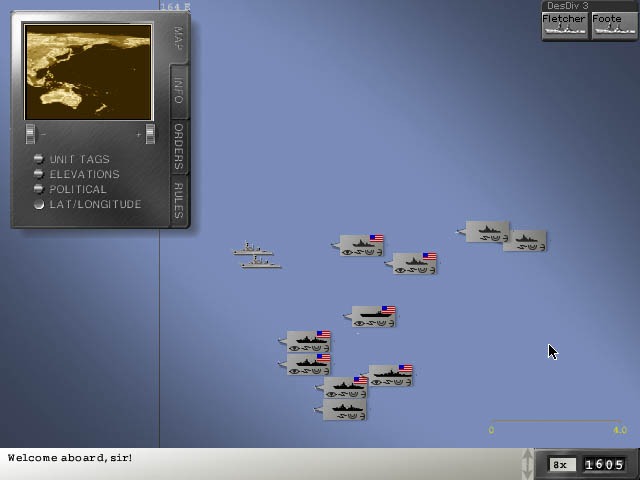 Q: Thinking back to 1992, I remember loading up Task Force: 1942 and setting up a night encounter between two battle groups. As they came within range the starshells began to burst overhead and the big guns began to let loose from my cruisers. I could almost smell the cordite and salt air. Tell us what this scene will look like from an outside view in Destroyer Command. Will we have opportunity to provide escort for a battle group? Troy: Absolutely! Our AI programmer is focused right now on providing decent task force-level tactics and behavior. We want the battles to feel real and we want the player to have the experience of screening the big boys in a major conflict. As for night battles, the Solomons really are the centerpiece of the Pacific campaign, so the night battles are a crucial element of the game. If there's any place where we will be pushing the 3D envelope it will be here. Expect to see star shells, flares and even search lights, as well as the flash of the big guns being fired and the flames of burning ships on the horizon. Q: Tell us about the command structure and how we earn promotion? Troy: There are still some tough challenges here. Our intent is to allow the player to play the game as a ship commander, a division commander and a squadron commander (1 ship, 4 ships and 8 ships, nominally.) Promotion is largely a function of objectives completed and we've taken the approach of providing both primary and secondary objectives for each scenario, weighting them by difficulty. What we're also doing, which I think is kind of unique, is to allow the player to decline promotion and continue at his current level if he so chooses. If you want to finish out a campaign as a ship commander, you are perfectly free to do so. This allows us to cater to the player who wants to focus on learning the ship's systems and "fighting his ship", while also supporting the armchair admirals out there who want tactical command of a larger group. It's kind of a logical outgrowth of our hybrid approach-- part immersive simulation and part strategy game. Go to Part II.
|
|||
|
Copyright © 1997 - 2000 COMBATSIM.COM, INC. All Rights Reserved. Last Updated November 9th, 1999 |
||||