
|
(I/ITSEC) Conference Part II
by Eric Larson, LT USN January 12th, 2000 |
||||
|
F/A-18C On the morning of the last day of the conference I stopped by the Boeing booth featuring the F/A-18C simulator. The tech on station was preparing the sim for an HLA demonstration (High Level Architecture - the buzz-word at the conference this year. If your sim is compliant, you can link with others over a network.) We talked for a while and I asked him several questions while he had time. When he had to move on, I asked if I could sit in the 'pit for a while and just look around. All of the buttons were inactive so I could push and pull on everything and not worry about it. Free licence to "play," aye! :D The simulator was arranged somewhat like the Raytheon F-16 simulator: Instead of a dome (which provides seamless field of view), the visual image of the world is projected on flat planes, only on this sim there were fewer and simpler polygons. A square plane straight ahead, trapezoids everywhere else. Not as "geodesic" in appearance as the F-16 sim. As in the Raytheon simulator, the HUD was projected onto the scene ahead - no combiner glass was present. There was also a head-tracker that would distort the projected image so that it would appear seamless as possible to the observer. The HUD also moved in response to the viewer's head position. The terrain was photorealistic. The area represented was the Nellis range. It appeared as if the terrain was rendered to the horizon. The sky had no weather, but there was a distinct haze layer on the horizon. The cockpit was a full-up model with real working gages, CRTs, HOTAS, etc. The only thing different was the lack of a canopy bow and the ejection seat was actually a special unit fitted with force-feel (The seat would vary pressure at different points to simulate the forces a pilot feels as the jet manuevers. The pilot has to be strapped in to receive the maximum effect.). The cockpit, I found, was not completely inert at this point: The engine instrumentation in the lower right portion of the instrument panel was responding to throttle inputs. I counted seven seconds to spool up to full military thrust from idle and ten seconds to spool back down again. The dual throttle levers were easily moved individually. There didn't appear to be anything connecting them together - they were very free to move as single levers. I didn't expect that. An additional note about the throttles - they don't seem to be designed with ergonomics in mind. Trying to manipulate the HOTAS controls with the throttles at the full forward position was very difficult. The buttons on the front of the throttle handles were rotated away from your hand making manipulation difficult. Just getting the throttles into the afterburner regime required pulling up a pair of lifts - which was difficult for me to do since the throttles were - again - rotated away from my hand at the full forward position. |
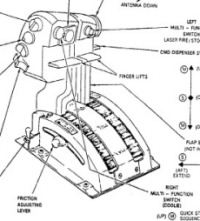 The HOTAS configuration itself was very simple. On the top of the stick there is the pickle button, castle and coolie hat. The tumb position is on the side, a trigger and a pinkie switch are located just like a Suncom joystick. Whereas the JS is favorably modeled by the Suncom Talon, the throttle is different than anything on the commercial market. There is a large button on the front that controls the cursor in the current SOI (sensor of interest - the active display which will receive control input), a radar elevation wheel located almost between the two levers (actually, if you can follow this, its on the inboard forward edge of the port throttle lever - accessible by the middle finger), a speed brake button on the top and inboard side and a comm switch below the speedbrake switch. One switch is on the far side (pretty sure that controls external lights). And of course the throttle lifts in front. That's pretty much it! Very simple. A lot of the work in the cockpit is actually done on buttons on the instrument panel around the MPDs (multi-purpose display). Also, each button on the HOTAS has several functions - functionality for a lot of the HOTAS buttons and switches is dependent upon current modes, etc. I also noted that the MPDs were not monochrome - they had the standard green text, but also yellow (and I think I remember red, too). Later that day I was able to pull myself away from my duties at my booth (there were two of us there and my partner took over for me) and got in line at the F/A-18 simulator. Naturally, there were a couple former Navy F-18 pilots there and we struck up a conversation while I was waiting. There was also a former A-4 pilot (Vietnam vet) that had a lot of good input, too. He currently works for a contractor out at Edwards AFB and was interested in the force-feel seat. I was in line behind two Swedish Gripen pilots. I made a mental note to speak to them about their impressions of the F-18. The Gripen pilot in the seat flew around the area looking at the terrain, did the obligatory aileron roll (GOTTA fly upside down! :D) and flew in formation with a formation of current fighters (F-15, F-16, MiG-29, Su-27, some others. It was obvious the AI didn't have real flight models). Made an approach to Nellis, turned around on the runway, took off and flew around some more. He was getting plenty of help from the Hornet pilot at his shoulder. Go to Page Two.
|
|||
|
Copyright © 1997 - 2000 COMBATSIM.COM, INC. All Rights Reserved. Last Updated January 12th, 1999 |
||||