| from Attack Aircraft Proliferation: Issues For Concern by Christopher Bolkcom and John Pike |
||||
|
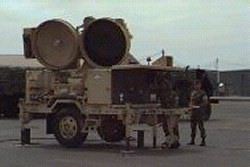
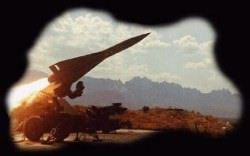
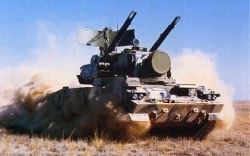
AIR DEFENSE MISSILES While overall air defense attrition is low, defenses can complicate or discourage an attack. Since they are defensive, an air defense system doesn't have to destroy aircraft to be effective. Deterring an attack all together would be an unmitigated success. Short of deterrence, forcing an attacker to choreograph an attack in a less efficient way, or forcing him to employ extensive assets to defeat radars and interceptors would also be measures of air defense success. Modern air defense systems rely primarily on high velocity surface to air (SAM) interceptor missiles to destroy attacking enemy aircraft. At the small end of the scale are man-portable, short-range SAMs such as the British Javelin, the Russian A-7 Grail, the US Stinger and Redeye. All are about 1.5 meters long and weigh less than 16 kg. 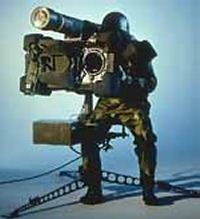 Swedish RBS70 These systems have ranges against aircraft typically less than 4km. The emergent British Starstreak man-portable SAM boasts a Mach 6 interceptor that should increase performance over Javelin considerably.(42) Although limited by their short range, these class of weapons have proved effective against aircraft, most notably by the Afghans versus the Soviets. Since these systems are so small, aircraft often are surprised, and thus, the advantage swings to the SAM. While accuracy, speed and invulnerability to counter-measures is obviously important, the primary measure of merit for air defenses is range. The longer the range of the defensive system, the larger the "foot print" attacking aircraft need to defeat or avoid. While the 4 km radius of a man-portable system may seem quite large -- most of Washington, DC for example, would fit within an 8 km diameter circle -- it really amounts only to point defense against aircraft. Attack aircraft are free to maneuver at will outside the 4 km range and pick the most advantageous direction and angle of attack. An aircraft attacking at Mach 1 would travel the 4km from the weapon's range to the defender in 11.6 seconds.(43) A Stinger or Javelin operator would have 11.6 seconds to survey, identify, and fire at an attacking aircraft dropping a standard "dumb-bomb." In a best case scenario, the aircraft ignoring the defender and bisecting the weapon's interception diameter, the defender would have 22.2 seconds to engage the aircraft at Mach 1. By contrast, a system with a 100km range - such as the A-10 Grumble or the Nike-Hercules - would have almost 10 minutes to engage an incoming target in a best case scenario. In addition to increasing range, air defense effectiveness can be increased by layering and integrating systems to provide supporting fire. The US Forward-Area Air Defense System (FAADS), for instance, will combine vehicle-mounted short range SAMs for terminal defense and longer range systems for maximum line-of-sight engagement with the Fiber-Optic Guided Missile (FOG-M) form beyond line-of-sight intercepts. The missile's infrared or TV camera will transmit images to a concealed operator via a trailing fiber-optic cable. The advent of longer-range air-to-surface weapons allows aircraft to attack SAMs and air defense radars with either brief or no exposure to the interceptors envelope. Thus, another means of increasing the effectiveness of air defenses is to enhance their survivability to attack. To reduce vulnerability to anti-radiation munitions (ARM), air defense systems are turning toward infrared target acquisition sensors and making use of improved electronic countermeasures. PROLIFERATION OF SAMs Producing air defense missiles is beyond the technological capability of most countries. The United States, Former Soviet Union and the industrialized West European countries are responsible for the bulk of SAMs. Nevertheless, surface-to-air missiles are found in the inventories of at least 94 countries. The USSR and former Warsaw Pact countries (including the former GDR) boasted at least 7,000 air defense systems. Data on these countries is sketchy and inconsistent, and the number could be up to 9,000. These systems ranged from the hand-held 4km SA-7 to the SA-5/10 and 12. These latter systems have ranges between 100 and 300km and some capability against tactical ballistic missiles. NATO countries, not including the United States, field at least 2,900 air defense systems. Of this figure, however, at least 2,148 are "short"range.(44) While only the Soviets produced the air defense systems for the former Warsaw Pact, several countries -- France, Great Britain and the United States, and international concerns -- produce these weapons in the West. Other European countries -- Albania, Cyprus, Finland, Ireland, Sweden, Switzerland and Yugoslavia -- own more than 100 air defense systems. In 1991, only Sweden fielded an American system (the Improved Hawk), French and Soviet systems make up the inventories of the remaining countries. At the very least, there are 4,500 air defense systems in the Middle East and North Africa. More than half have a range of less than 11km. Sub-Saharan African countries have at least 435 air defense systems. Over 100 of these systems are of the shortest range. Australia and Asian countries own more than 3,500 air defense systems. Approximately 2,000 of these weapons are short range. In addition to the ubiquitous French, American and Russian systems, the Chinese, Taiwanese and Japanese all have their own systems. Latin America and the Caribbean are home to approximately 1,000 surface to air systems, very few of these systems have ranges over 50km and the vast majority are of the shortest range. Between 1985 and 1989 22,282 SAMs were delivered to the developing world. Of this total, 17,055 were delivered by the USSR, 110 by other Warsaw Pact countries, 1,176 by the United States, 930 by France, 81 by the United Kingdom, 145 by other NATO countries, 705 by China, 580 by other developed countries, and 1,500 by other developing countries.(45) |
ANTI-TACTICAL MISSILE DEFENSES While even short range systems have illustrated utility in defending against aircraft, very long range SAMs have the potential to alter the shape of the battlefield. Some air defense SAMs with the requisite range have reached a level of sophistication such that they have some capability against both cruise and ballistic missiles. They are, for this reason, distinct from previously mentioned systems. Both the US and USSR have focused attention on programs to upgrade air defense systems to make them capable of destroying ballistic missiles and cruise missiles. Current systems include the U.S. Patriot, and the Russian SA-5, SA-10 and SA-12, and the American Strategic Defense Initiative is currently developing a number of additional systems.
Hawk Phase III - Improved versions of the Hawk anti-aircraft missile have been tested against missile targets in conjunction with the Patriot fire control radar, leading to a successful intercept of a target missile on 5 April 1988.(46) Patriot PAC-1 - The first phase of the Army Missile Command's Patriot Anti-tactical missile Capability consisted of software upgrades to enable the Patriot fire control system to engage missile targets. Following a series of tests from 1984 through 1987 that included intercepting a Lance target missile, this system was declared operational and entered service in 1988, providing a limited self-defense capability. PAC-1 Patriot is widely deployed with American and European land forces. Patriot PAC-2 - The second phase of the Patriot Anti-tactical missile Capability provided the Patriot missile with a larger more lethal warhead and an improved fuse to increase the interceptor's lethality against ballistic missile. A test program of 8 flights in 1988 and 1989 included several intercepts of missile targets. The system entered field service in 1990, providing a capability to intercept Scud-class targets. The PAC-2 Patriot was reportedly deployed with American forces in Saudi Arabia. ERINT - The Extended Range Interceptor project is being conducted for the Strategic Defense Initiative by the Army Strategic Defense Command. As with the earlier SR-HIT (Short Range Homing Intercept Technology) and FLAG (Flexible Lightweight Agile Guided) Experiments, ERINT uses an on-board millimeter-wave radar in the nose of the interceptor itself for guidance, in contrast to systems such as Patriot which rely on a ground-based radar for guidance. The smaller ERINT (a Patriot launcher could carry 167 ERINT in place of 4 Patriots(47)) will offer improved performance against the Scud and longer range missiles. But since it is not part of the Phase One initial deployment plans for SDI, initiation of the ERINT test program has been delayed from 1991 to 1993.(48) The Theater High Altitude Air Defense system is a $300 million SDI effort to develop an integrated two-layer wide-area defense against aircraft and missile threats.(49) Selection of a development contractor is anticipated by late 1991, with tests continuing through 1996. The first-layer interceptor missile chosen would be larger than Patriot or ERINT (which would be the second layer interceptor(50)), though smaller than the Arrow. Arrow - The Arrow (Hetz) is a medium range anti-missile interceptor developed by Israel Aircraft Industries. The American SDI program is paying 80% of the initial $200 million cost of the project, which received high priority after the cancellation of the Lavi fighter.(51) The Mach 10 interceptor has a maximum range of 70 Km at an altitude of 30 Km.(52) This large interceptor is intended for defense against ballistic missiles with ranges up to 1000 Km. Four tests were planned through the Summer of 1991. A follow-on 3 year contract for $200 million was approved in 1990, with development and production costs through the rest of the decade are estimated at nearly $2 billion.(53) Given technical problems with the systems radar and command system,(54) coupled with its high development cost, the Arrow program may soon fall by the wayside. The Soviet Union also developed a range of anti-aircraft interceptors with some anti-tactical missile capability.(55) SA-5 Griffon and Gammon - The SA-5 Griffon was originally developed as part of the `Tallinn' strategic anti-missile system in the early 1960's, and was judged to have both an anti-aircraft and anti-missile capability. But the Soviets were apparently un-impressed with its ABM potential, as it has actually been deployed in the heavily modified Gammon version in the anti-aircraft role. The missile has a comparatively modest acceleration rate, and relies on its small wings for maneuverability. Both characteristics reduce its ABM potential. Furthermore, the mechanically steered radars used by the SA-5 are vulnerable to saturation by decoys. SA-10 Grumble - The SA-10 is a new Russian SAM that is more capable than the rough American equivalent, the Hawk, which is credited with a limited tactical ABM potential. This system has primarily intended to counter very low altitude targets such as cruise missiles. SA-12 Gladiator/Giant - The SA-12 anti-tactical ballistic missile (ATBM) system is the most recent addition to the Russian's air defense arsenal, achieving operational status in 1984. Both the missile and its associated phased array radars are transported on a large tracked vehicles. There are two versions of the SA-12, the smaller Gladiator which is designed to intercept aircraft, and a much larger Giant version designed to intercept tactical or theater ballistic missiles.
Go to Comparative Table
|
|||
|
© 1997 - 2000 COMBATSIM.COM, INC. All Rights Reserved. Last February 27th, 1999 |
||||