
|
Destroyer Command Interview
by Leonard "Viking1" Hjalmarson |
||||
|
Q: You are also simulating the air environment. What kind of aircraft are a threat to my ships in the Atlantic campaign? Troy: In general, we've modeled fighters, high level bombers, dive bombers and torpedo bombers and made sure that each of the major combatants represented in the game (US, Japan, Germany) have at least one example of each. In the Atlantic, we've got the following German planes:
How does weather effect with my missions in Destroyer Command? Troy: Two ways, primarily: 1) High sea states result in lower speed for ships and convoys. 2) Atmospheric conditions and precipitation affect the ability of lookouts to detect and track other ships. We've also modeled moving weather fronts, so it's possible for ships to slip inside of such a weather front in order to hide. Q: Tell us about Intel. How do we receive intelligence updates while on a mission, and from what sources? Troy: Intel is primarily a function of the initial briefing. However, sightings of enemy shipping and aircraft may occur as radio events in the game, either from scout planes, coast watchers or other ships in a task force. Q: How much is the radio of use to us, and is there a separate radio-room station?
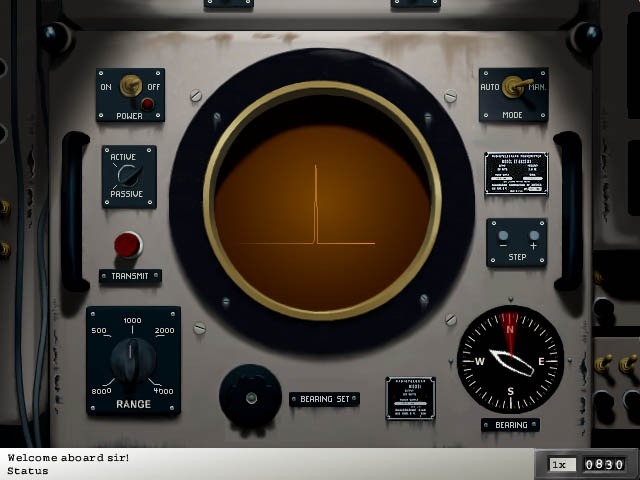 Sonar Station Troy: We opted not to provide an actual radio room, but instead to provide a message log which appears on every station. In the words of one of our consultants, "It's just a room where a guy sits with a typewriter that has only capital letters and transcribes incoming morse code, decrypts it and rushes it to the appropriate recipient." Didn't sound like very much fun to us. In addition, US Navy doctrine was to avoid transmitting long-range signals from ships to avoid the possibility of the enemy intercepting the messages and determining the location of the group from the signals. Since the radio was primarily seen as a source of incoming messages, we felt that the message log was the best way to handle it. |
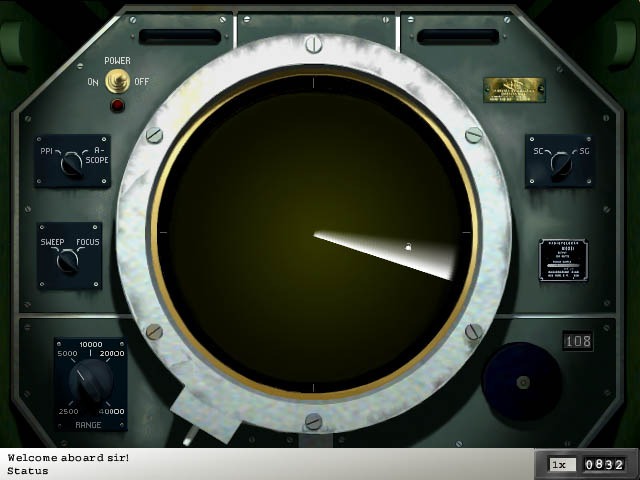 Radar Station Q: What kinds of messages can we initiate from the radio? Can we call in air support in some locations? Can we report on a battle group position? Troy: I was thinking that Destroyers never had control of aircraft, but then I remembered the hunter-killer groups formed in the North Atlantic. I'll need to research this a bit. You may have made a good case for having a radio room... As to reporting enemy sightings, this is something we already do behind the scenes without the player's intervention. We really felt that the player would want to concentrate on fighting his ships, so we leave these details to the AI. Q: You are modeling both radar and sonar. There were significant changes in these systems through WWII. How do these changes affect game play? Troy: Sensor effectiveness is something we are very keen on modeling accurately. To that end we've included both SC and SG radar sets and players won't get the more accurate SG surface search radar until early '43. This parallels the radar options in the original Silent Hunter, which featured the submarine variants of these two radar sets. Actually, sonar didn't improve that much on US Navy ships until near the end of the war. The bulk of the US destroyer forces used the QC "searchlight" sonar for most of the war, which had an effective range of maybe 2000 yards. Q: In the same way changes in weapon systems forced changes in tactics throughout the war. Tell us improvements and changes you have modeled in torpedoes through the campaigns. Troy: American torpedoes are one of the great tragedies of the war and the ineffectiveness of early models really prevented destroyers from realizing their potential as offensive weapons. Of course, US Navy doctrine didn't help and it took guys like Fred Moosbrugger and Arleigh Burke to show them the potential of the destroyer in this role. That said, if you leave the realism settings on maximum, American torpedoes will basically suck until 1943. You'll see depth-keeping errors and faulty detonators as was the case in real life. However, we will allow the player to turn off realistic torpedo settings as a means of avoiding that particular frustration. Go to Part V
|
|||
|
Copyright © 1997 - 2000 COMBATSIM.COM, INC. All Rights Reserved. Last Updated November 9th, 1999 |
||||