
|
Enemy Engaged: Comanche vs. Hokum Interview by Leonard "Viking1" Hjalmarson December 16, 1999 |
||||
|
Q. Will we have any control over movement of friendly ground forces? Will we interact/communicate with them in any way? A: They will communicate with you. If they are advancing they will tell you where to, and if they are under attack they will tell you where they are and request assistance. The only real interaction you have with friendly ground forces is when you request an artillery strike. Q. Will we see actual infantry moving about in C-H? Will we fly insertion and extraction missions? A: Yes, infantry will be seen patrolling airbases and other military installations, and also dropping out of Hinds and Blackhawks to capture enemy facilities. You will be able to fly as escort to these insertion missions.
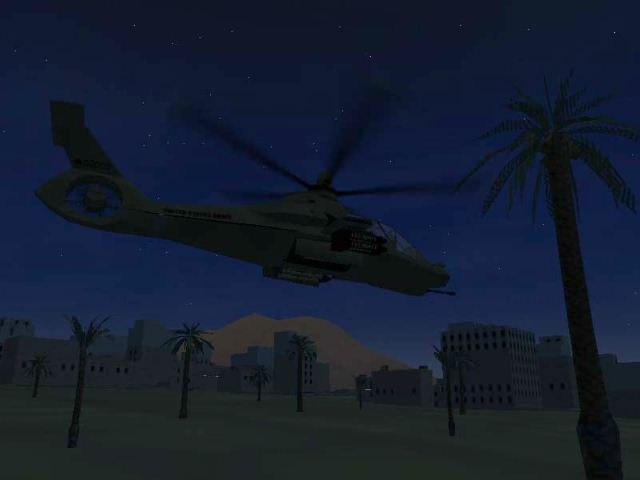 Q. Will infantry present a real danger to my chopper? A: Some infantry carry shoulder-launched SAMs that definitely pose a threat to your chopper. Q. Tell us about changes to the interface. A: The user interface is yet another part of Comanche-Hokum that has been re- written rather than changed. This was necessary to give us features such as allowing the interface to be drawn at any resolution, and the ability to draw animated 3D objects in the front end. Apart from the technical side of things, the user interface has also been re-designed to make it a lot more intuitive and easy to navigate around. Q. How is intelligence presented to the player between missions? A: Apache-Havoc was severely lacking in this department - there was such a lot going on in the campaign but the user rarely got to know anything about it. Comanche-Hokum is the complete opposite in this respect - basically you have access to everything that is happening in the game. You can easily bring up details on every single mission, airbase, farp, factory, tank, jet, helicopter etc. Briefings and debriefings are a lot more detailed than in A-H, and are not just restricted to the player's missions either. There is also a constantly updating event log which keeps you informed of all manner of events and where they happen, such as units under attack, missions completed/failed, farps captured/lost, etc. You aren't just limited to accessing intelligence between missions either, because of the nature of the fully dynamic campaign all information is equally accessible both between and during missions. |
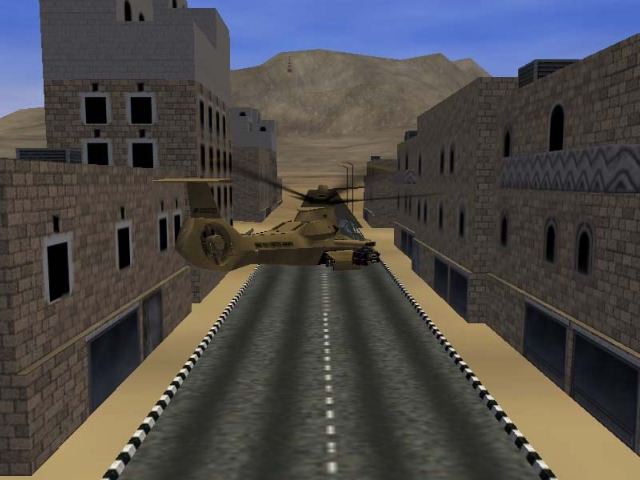 Q. Tell us about debriefs, mission stats. Will we have enduring pilot records? A: Mission debriefings are still being implemented, but currently contain the following information: Success rate (complete success, partial success or failure). A list of targets destroyed by each member of your group. A list of any wingmen casualties and how they were killed. Plus we can also overlay the actual route the player flew on the map. Yes, there will be an enduring player log - storing information such as number of missions flown, flying hours, kills, losses, campaigns won etc. Plus there is a full complement of medals to be collected for each side: - Medals may be awarded upon completion of a mission and range from the Purple Heart to the Medal of Honour. Wings are awarded for flying hours clocked up, and there are special medals awarded for successful completion of each campaign.
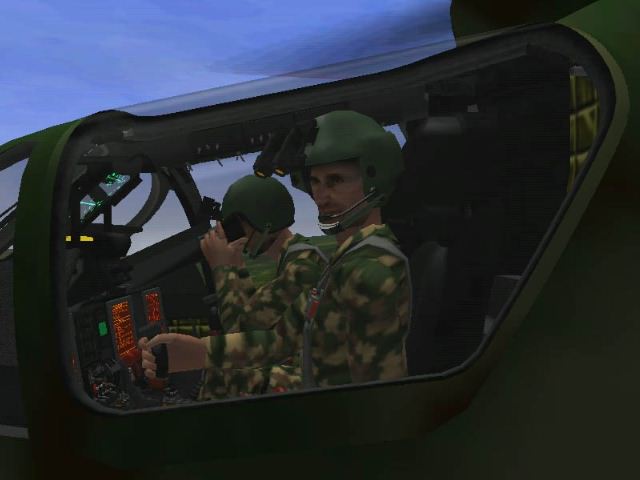 Q. From the look of the cockpits avionics have become more detailed. What kinds of changes will we see here and what difference does it make for the user who wants a higher degree of realism? A: The avionics are similar to A-H but there are several new MFD pages. Avionics have been added to improve the gameplay rather than increase the micro-detail. For instance, a 'Mission' MFD page has been included so that if you 'hop' from one gunship to another in-flight then you just need to look down to see what it is you're supposed to be doing. This saves returning to the planning screen. An advantage of the Comanche over the Hokum is that the Comanche has 4 displays in each cockpit so that 8 of the total 10 MFD pages are always visible (if you switch cockpits). Go to Page Four.
|
|||
|
Copyright © 1997 - 2000 COMBATSIM.COM, INC. All Rights Reserved. Last Updated December 15th, 1999 |
||||