
|
The Interservice/Industry
Training, Simulation and Education Conference (I/ITSEC)
by Eric Larson, LT USN January 10th, 2000 |
||||
|
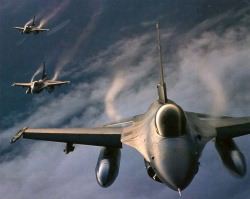
F-16C (block 52) The next day I peeled myself away from the SPAWAR booth and just "took" the time to wait in line for Raytheon's F-16 sim. This one was on the convention floor housed in a very large structure. It had caught my eye early on and I'd taken time to make friends with the techs in the days preceding (I couldn't take the time to actually fly then, but I did have a few minutes to talk). It helped having experience on the carrier because I've picked up the jargon of aviators and know a little more than the average bear about military aviation through flight sims. A steady diet of F4, Janes F15 and the like helps! :D There were also a few -16 pilots hanging out around the sim the day I flew, too, so it wasn't long before we were shooting the... breeze and comparing sea stories. (Do Air Force pukes have "sea stories?" What do they call 'em? A rethorical question... :D) But, with them looking over my shoulder, I ensured I'd get sound instruction on weapons employment! So, even though there were Egyptian Air Force officials and other corporate heavy-hitters there, the guys made sure I got a ride. There didn't appear to be any time limit - everyone was just taking as much time as they like. Which was a little annoying knowing your boss is probably wondering where you are, but I figured, "Hey, I may never get this opportunity again!" So - to HECK with it! :D But the routine seemed to be to start out in flight, do some close maneuvering with a KC-135, maybe do some weapons work and shoot an approach at an airfield. Pretty much a half hour of fun. For free, I might add (yeah - I know I'm lucky!) The EAF guy was an older gentleman and obviously a pilot. He maneuvered up close to the tanker and actually got in position. He was porpoising (sp?) quite a bit at first, but soon got it under control. The tanker wasn't flying with a real flight model and the alignment lights were inop as well. Neither did the boom work. Nor were there any turbulence effects associated with flying in the wake of the tanker. Soon he was making his approach (a tech nearby informed me that he put the boom through the canopy twice) and broke away after a little form flying. Made an approach to an airfield, landed, turned around, took off, flew around some more (I'm getting annoyed about now), kept flying... He must have been a transport pilot because he was flying around all gentle like. This guy was apparently considering a purchase - they weren't hustling him out of there. Finally it was my turn. Once strapped in with head sensor mounted I took a look around. The cockpit was a full-up production cockpit - fully articulated instrumentation and, I was told, an un-adulterated flight model! No holds barred here. (Well, the techs whispered to me earlier that all mention of special weapons were removed and no threat weapon systems were present - for demo purposes. The whole conference was classified UNCLASS). The scene was projected onto flat shapes (like a geodesic dome) surrounding the cockpit. For the demo, however, only the forward panels (to the 3-9 line) were in place. The sim started with the a/c placed about 5nm astern of the tanker. I was immediately struck with the appearance of the HUD symbology. It was very clear and very thin - but actually much larger than what I expected. After many hours in MPS' Falcon4.0 I've grown accustomed to rather small HUD symbology. In fact, when you press "Look" and look through the HUD in F4 you see enlarged symbology. That's what the normal view looked like. |
 Another point: There was no physical HUD combiner glass assembly, either. Like the system before, the projectors "create" the HUD image. Furthermore, when your head moves, the HUD image moves on the screen to simulate what you'd see in the the real thing (remember, it's just a reflection in the real deal). It even disappears when the image "would have" left the glass. And if you leaned forward, the image got physically smaller, but retained the same apparent size to the guy in the seat since he moved his head closer. (Was that clear as mud?) Not only the HUD image, but the overall scene moves so that you don't perceive any foreshortening due to mapping a curved space (your perspective of the world) onto flat surfaces. That must be some fancy mathematics going on behind the scenes... which would explain the *bank* of five or six SGIs out back! (By the way, that's Silicon Graphics for those who aren't familiar. We get excited about 133MHz bus speeds, these machines are pushing the 27GHz bus speed. Yes, I typed "G"!) As the world started moving I began the approach to the tanker. Controls were *heavy* - not kidding. I was over controlling causing a porpoising motion and during rolling motion I would "ratchet." Yes, the F-16 is a fly-by-wire aircraft and it senses the force you apply to the stick, but you really need to push just to get a slight roll going. And then the inertia raises its head. Thinking back at it now, the jet just FELT heavy. It would keep rolling after you released the stick. So, even on approach, I was ham-fisting it. Long story short, I never did actually get in position - even with the F-16 pilot crouched right next to my left shoulder giving me a play-by-play. Interesting engine note (and you could hear the engines faintly in the background along with the afterburner - had to concentrate to hear it, though) - it took about a second for the engine to change to a new setting. You could hear the wind up and it was up to speed in about a second. One note about my "instructor" - I'd asked to experiment with the weapons systems so all the while he was having me "push forward on the castle," "select TWS on the MFD," "select AIM-9" throughout my flight. Great stuff. I was quickly getting overwhelmed! Go to Part IV
|
|||
|
Copyright © 1997 - 2000 COMBATSIM.COM, INC. All Rights Reserved. Last Updated January 10th, 1999 |
||||