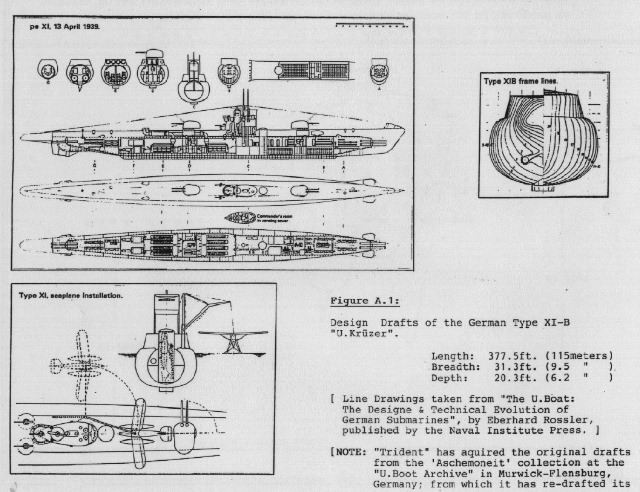
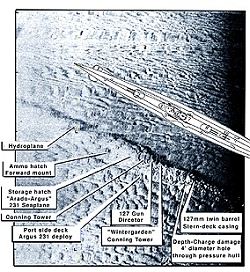
| Type XIB Uboat From "Sub Sea Recovery: CA-35" |
||||
|
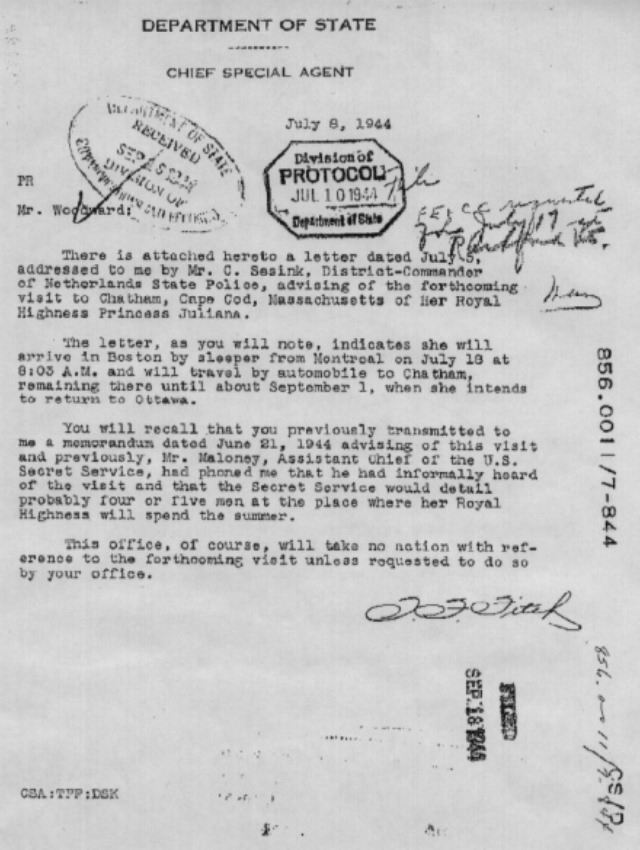
RECENT RESEARCH There has been some very interesting revelations in the Project's follow-up of research data. Due to the efforts of contributing researcher Mr. Eric Brothers, U.S. State Department Protocol documents are now available to confirm one of this investigation's long-standing curiosities - the visit of members of the Dutch Royal Family to Chatham, Cape Cod during the exact time-frame in which the German Type XI-B U-Boat was known to have been operational off Cape Cod. Some of these facts include:
Suffice it to say that there is the very strong possibility that Prince Consort Bernhardt, through his wife Princess Juliana, may very well have been acting as a sort of liaison or facilitator in connections for Armistice Negotiations between German Industrialists and certain members of the American Department of State and Intelligence Community. The final proof for this is as yet not confirmed, but the stage is certainly set for such endeavors. Perhaps the amplified documentation for such a situation is contained within the hull of the Type XI off Cape Cod. In response to a recent email enquiry, the President of Trident Research commented: We have a great deal of data and site observations. The vessel on the ocean floor is "Werke Nr. 977 - Deschimag", as noted on a copper label on the bronze expansion ring at main conning tower hatch. This is the builder's yard number for the Type XI-B, which would have been the U-112 - had it been commissioned into the Kriegsmarine, which it was not of course. Instead, the vessel was handed over to the Abwehr Bremen sub-branch and eventually operated out of both Vigo, Sp. and Lisbon, Portugal until ultimately being transferred to Gdynia just prior to her last voyage. Indeed, there are many details we have not released publicly. However, all of our site operations and discoveries are recorded in minute detail with the Federal Court in Boston, (Civil Action No. 95-11374RCL). These records are public record, although we do not go out of our way to broadcast this as we have already had site problems with security. Even now, the Navy has positioned 4 sono-buoys around the wreck, without our consent, which is playing havoc with our magnetic surveys and side-scan sonar! As you probably know, we have had a great deal of diplomatic problems with both the State Dept. and Navy Depts. - not surprising considering the content of the vessel, (which I cannot talk about at this time unfortunately). |
The ship is under sixty feet of sea water at high-tide, with 15 ft. sand ridges on either side of the hull, (which at times can cover various parts of the casing. Although this is shallow water, it's an area of EXTREME sea currents - averaging 4 - 5 knots. The lowest measured velocity was 2.5 knots, which occurs twice a day for ten minute stretches. When the surface is calm enough, (which can be rare), we get our best pics during the 2.5 knot period. The wreck itself is imbedded in deep soft sand up to the edge of her casing most of the time. The period of most exposure occurs during the spring, which is also the best time for visibility, which increases to around 2-3 feet. Depth is not the problem. Currents tend to make this site very difficult.
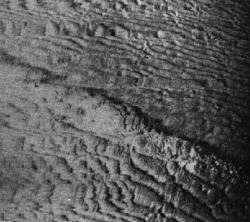 In the Sonar negative # 425 you can clearly see the after armored gun-mount askew on the casing, with one barrel of two visible. Next to that, (toward the stern), you can just make out the smaller single-barreled armored mount, also askew. The forward mount fell off the casing when the vessel took her final death roll to the bottom. We found that forward mount just to the south sitting in the sand upside down (see Part 5 for more photos).
The entire wreck is festooned with all sorts of large and small fishing nets, weights, etc. Some of this we have already cut away, but we have a long way to go on that! Needless to say, all of what we do has to be conducted according to accepted Archaeological procedures, which can be very time consuming. Go to Page 5
|
|||
|
© 1997 - 2000 COMBATSIM.COM, INC. All Rights Reserved. Last Updated January 26th, 1999 |
||||